
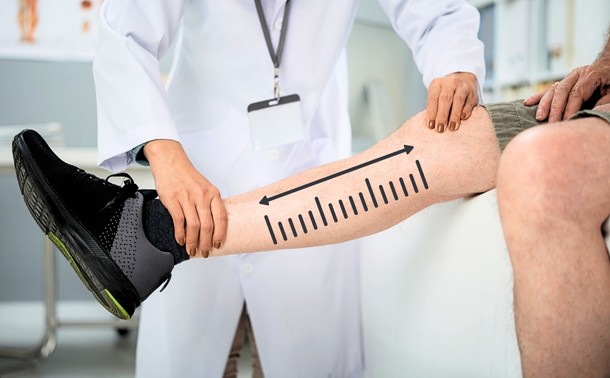
Most people asking this question are hoping for something like “ten days.” That is the right answer for a nose job and the wrong answer for an operation that cuts both your femurs on purpose and then pulls the halves apart, a millimetre at a time, for the next two or three months.
The useful way to think about your stay is not as a hotel booking but as a question about which phase of treatment you are willing to go through away from the people who operated on you. Once you see the phases, you can work out your own number — and you can tell the difference between a clinic that has thought about your eleventh week and one that has thought about your flight home.
General information, not medical advice. Only an orthopaedic surgeon who has examined you and seen your X-rays can tell you what applies to you.
The Four Phases, and Why Only One of Them Is Short
Cosmetic limb lengthening — often searched as height increase surgery — works by distraction osteogenesis. The bone is cut, a device holds the ends in alignment, and those ends are separated slowly enough that new bone forms in the gap. Four distinct phases follow, and they do not compress.
Surgery and the first days in hospital. Bilateral femoral lengthening with an internal nail typically means a few nights as an inpatient: pain control, wound checks, learning to transfer from bed to chair, the first physiotherapy sessions. This is the only phase that resembles a normal surgical stay.
Latency. For roughly five to seven days after the osteotomy, nothing is lengthened. The bone is allowed to start its healing response before distraction begins.
Distraction. This is the phase that sets your stay. Bone is typically lengthened by around one millimetre a day, usually split into several small increments. At that rate, six centimetres takes in the region of two months; eight centimetres takes closer to three. During distraction you need X-rays roughly weekly to check rate and alignment, daily physiotherapy to keep muscles and nerves stretching with the bone, and someone with the authority to slow, pause or stop the process if the soft tissues are not keeping up.
Consolidation. Once the target length is reached, the new bone has to harden. This takes months — usually longer than distraction itself — and weight bearing is restricted until the regenerate can carry you. Then, a year or more later, the nail is usually removed in another operation.
Your stay in Istanbul is a decision about where you will be for phase three, and who will be watching.
What Changes the Number Most: The Device
Lengthening over nail (LON) combines an internal nail with an external fixator. The frame does the lengthening; at the end of distraction the nail is locked with screws and the frame comes off in a second operation. That second operation has to happen where the surgeon is. In practice this means you stay through the whole distraction phase — commonly around three months for a typical gain — because leaving with a fixator on your legs and returning for removal is neither practical nor safe.
A motorised internal nail (the titanium Precice family is the most widely used, since the stainless-steel Stryde version was withdrawn in 2021) lengthens from inside the bone, driven by an external magnetic controller you hold against your thigh several times a day. There is no frame, no pin sites, and no removal operation at the end of distraction. That is why some centres allow patients to fly home after the first few weeks and complete distraction under remote supervision — and why others insist you stay until distraction is finished. Both positions are defensible; what matters is that the clinic can explain which it takes and why.
The difference can be two months of your life, a large share of your total budget, and your entire follow-up model. So before you ask how long, ask which device.
What the Published Numbers Say About Needing Someone Nearby
A systematic review in Bone & Joint Research pooled 11 studies covering 795 cosmetic lengthening patients. Mean gain was 6.7 cm, mean follow-up 4.9 years, and the authors counted events per patient using the standard three-tier classification: on average 0.78 “problems” (resolved without surgery), 0.94 “obstacles” (resolved with a procedure) and 0.15 true complications. Add those together and the typical patient had close to two treatment-relevant events. The most common problem was ankle equinus — the foot being pulled into a pointed position as the calf muscles tighten.
Read that the way a planner would. Most of those events are manageable; the point is that managing them requires someone to notice early and intervene. A tightening Achilles in week five is a physiotherapy and splinting problem if it is caught, and a surgical one if it is not. A distraction rate that is outrunning your nerves is a dose adjustment if someone reads your X-ray, and a nerve injury if nobody does. “How long do I stay” is really “who catches this if it happens to me.”
The Physiotherapy Problem Nobody Budgets For
Daily, specialist physiotherapy during distraction is not optional, and it is not the same thing as the rehab you would get after a knee replacement. Muscles, tendons, nerves and skin have to lengthen at the same pace as the bone, and they do not do so on their own. The work is specific: knee and hip flexion, ankle dorsiflexion, iliotibial band stretching, gait retraining on a walker or crutches.
If you go home mid-distraction, ask yourself three honest questions. Does a physiotherapist near you have limb lengthening experience? Will they accept written protocols from a surgeon abroad? Can you get in every day, including weekends? If the answer to any of these is no, the cheaper option of going home early is not cheaper. It is the single most common way a technically good operation turns into a stiff, limping result.
Flying With Lengthening Legs
Long-haul immobility is a clot risk on its own. Stack it on top of recent bilateral femoral surgery, reduced mobility and months of limited weight bearing and you are compounding risk factors rather than adding them. Your surgeon should write down: when you may fly, what prophylaxis you will be on and for how long, whether you need assistance through the airport, how you will manage distraction adjustments and physiotherapy in transit, and who reviews your first X-ray after you land.
And plan the return trip before the first one. Internal nails are usually removed around a year to eighteen months later; LON patients have already had their frame off but still carry the nail. Some people have removal done at home, which requires a surgeon willing to take on someone else’s hardware. Some fly back. Either way it is part of the treatment, not an afterthought.
A Realistic Planning Range
Given all of that, here is how the stay tends to break down — as phases, with your own numbers filled in by your surgeon:
- Internal nail, staying through distraction: hospital days plus latency plus the full distraction period — for a mid-range gain, roughly two and a half to three and a half months in or near Istanbul, then home for consolidation.
- Internal nail, remote distraction: commonly two to four weeks on site to confirm the device is working, healing is on track and you can do the adjustments and exercises correctly — then home with a remote monitoring plan, weekly X-rays sent to the surgeon and local physiotherapy already booked.
- LON: the full distraction period plus the frame-removal operation and a short recovery from it — usually three months or more.
Anyone quoting you a single number before they know your device, your target gain and your home physiotherapy arrangements is quoting a package, not planning your care.
Questions to Get Answered in Writing
- Which device, and why that one for me?
- Will I stay for the whole distraction phase, or go home part-way — and if part-way, who reads my weekly X-rays and how fast do they respond?
- How many days of physiotherapy are included, with whom, and what happens at weekends?
- What is your protocol if distraction has to be slowed or stopped?
- When am I cleared to fly, and what clot prophylaxis will I be on?
- Who removes the nail, where, and when?
- What documentation do I take home — implant details, operation notes, X-rays — so a local orthopaedic surgeon can help me if something goes wrong?
The Short Version
The question of how long you stay in Istanbul after height increase surgery has a structural answer: as long as your distraction phase, unless you have a fully internal device, a clinic set up for remote supervision, and daily specialist physiotherapy already arranged at home. For LON, that is three months or more. For an internal nail, it is somewhere between a few weeks and the full distraction period, and the right number depends on what is waiting for you on the other side of the flight.
Count in months, not nights. Then ask the clinic to show you their plan for month two.