
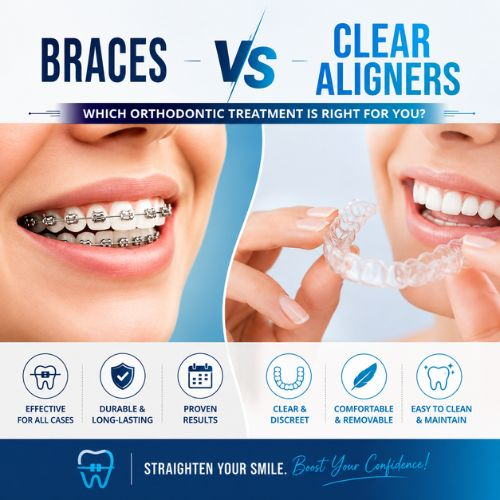
If you are considering orthodontic treatment to straighten your teeth, you have almost certainly come across the debate between clear aligners and traditional fixed braces. Both can produce excellent results, but they work differently, suit different patients, and come with different day-to-day experiences. The honest answer to which is better is: it depends on your specific situation, your lifestyle, and what you want from your orthodontic journey. Here is a clear-eyed comparison to help you have a more informed conversation with your orthodontic team.
How Each System Works
Fixed Braces
Fixed braces use metal or ceramic brackets bonded directly to the teeth, connected by a wire that is periodically adjusted to apply gentle, continuous force that gradually moves the teeth into the desired position. They are called “fixed” because they cannot be removed during treatment, they stay in place around the clock until the orthodontist removes them at the end of treatment.
Clear Aligners
Clear aligners in Altrincham use a series of custom-made, removable plastic trays that are worn over the teeth. Each set of trays is slightly different from the last, applying gentle pressure to move the teeth incrementally. Trays are typically changed every one to two weeks as the teeth progress toward their final position. Because they are removable, patients take them out for eating, drinking anything other than water, and cleaning their teeth.
What to Consider Before Choosing
The right orthodontic option depends on more than appearance. Your bite, tooth position, oral health, treatment goals and ability to follow the recommended treatment routine all need to be considered. A dental practice in Altrincham can assess these factors during an orthodontic consultation and explain which options realistically suit your needs.
Side-by-Side Comparison
| Factor | Fixed Braces | Clear Aligners |
| Visibility | Visible metal or ceramic brackets | Near-invisible when worn |
| Removability | Cannot be removed by the patient | Removed for eating and cleaning |
| Diet restrictions | Avoid hard, sticky, chewy foods | None, remove aligners before eating |
| Oral hygiene | More complex, special tools needed | Standard brushing and flossing |
| Comfort | Brackets and wires can irritate gum tissue | Smooth plastic, generally comfortable |
| Compliance required | Automatic, worn 24/7 | High, must be worn 20–22 hours per day |
| Suitable for complex cases | Generally yes | Depends on case complexity |
| Appointment frequency | Regular adjustments every 4–8 weeks | Check-ins less frequent |
When Clear Aligners Are the Better Choice
Clear aligners are particularly well-suited to patients for whom the aesthetic impact of treatment is a significant consideration. Adults in professional roles, patients attending regular social or work events, and those who simply feel strongly about not having visible orthodontic appliances during treatment consistently report high satisfaction with the aligner experience.
The removability of aligners is also a genuine practical advantage for patients who want to maintain their normal diet without restriction and who can maintain the discipline of wearing the aligners for the recommended twenty to twenty-two hours per day.
The Daily Commitment With Aligners
Although clear aligners in Altrincham are removable, their success depends heavily on wearing them for the recommended amount of time each day. They should generally only be removed for eating, drinking anything other than water, brushing and flossing. Patients who are comfortable maintaining this routine are more likely to stay on track with their planned treatment.
When Fixed Braces May Be More Appropriate
Certain orthodontic issues, particularly more complex movements, significant rotations, or vertical tooth movements, are handled more predictably with fixed appliances, where the clinician has more direct, continuous control over the forces applied to each tooth.
For younger patients or those who may struggle with the compliance required to wear aligners consistently, fixed appliances remove the variable of compliance altogether. If aligners are not worn consistently, treatment progress slows and outcomes can be compromised.
The clinical assessment carried out at a dental practice in Altrincham orthodontic consultation will determine which system is appropriate for your specific case, this is not a decision that should be made based on marketing materials alone.
The Importance of Retention After Either Treatment
Whichever orthodontic system is used, retention after treatment is essential. Teeth have a natural tendency to drift back toward their original positions after treatment, a phenomenon called relapse. Retention appliances, typically a fixed wire bonded to the back of the teeth and/or a removable retainer worn at night, maintain the result achieved.
This is one aspect of orthodontic treatment that applies equally to both systems, and it is worth understanding before starting. Orthodontic treatment is a long-term investment in your smile, retention protects that investment.
Invisible Does Not Mean Unnoticeable
A common misconception about clear aligners is that they are completely invisible. In normal social interaction and at conversational distances, well-fitting aligners are effectively unnoticeable to most people. However, under certain lighting or at very close range, they can be seen. For most patients, this level of discretion is entirely satisfactory, particularly compared to the visibility of fixed brackets.
Conclusion
Both clear aligners and fixed braces are effective orthodontic treatments; the better choice depends on your individual clinical needs, lifestyle, and priorities. The most important step is a thorough consultation with an experienced orthodontic provider who can assess your specific situation and provide an honest recommendation. The Good Dentist Altrincham offers both clear aligner and fixed orthodontic treatment, with consultations that focus on what is right for each patient rather than what is easiest or most convenient to provide.