
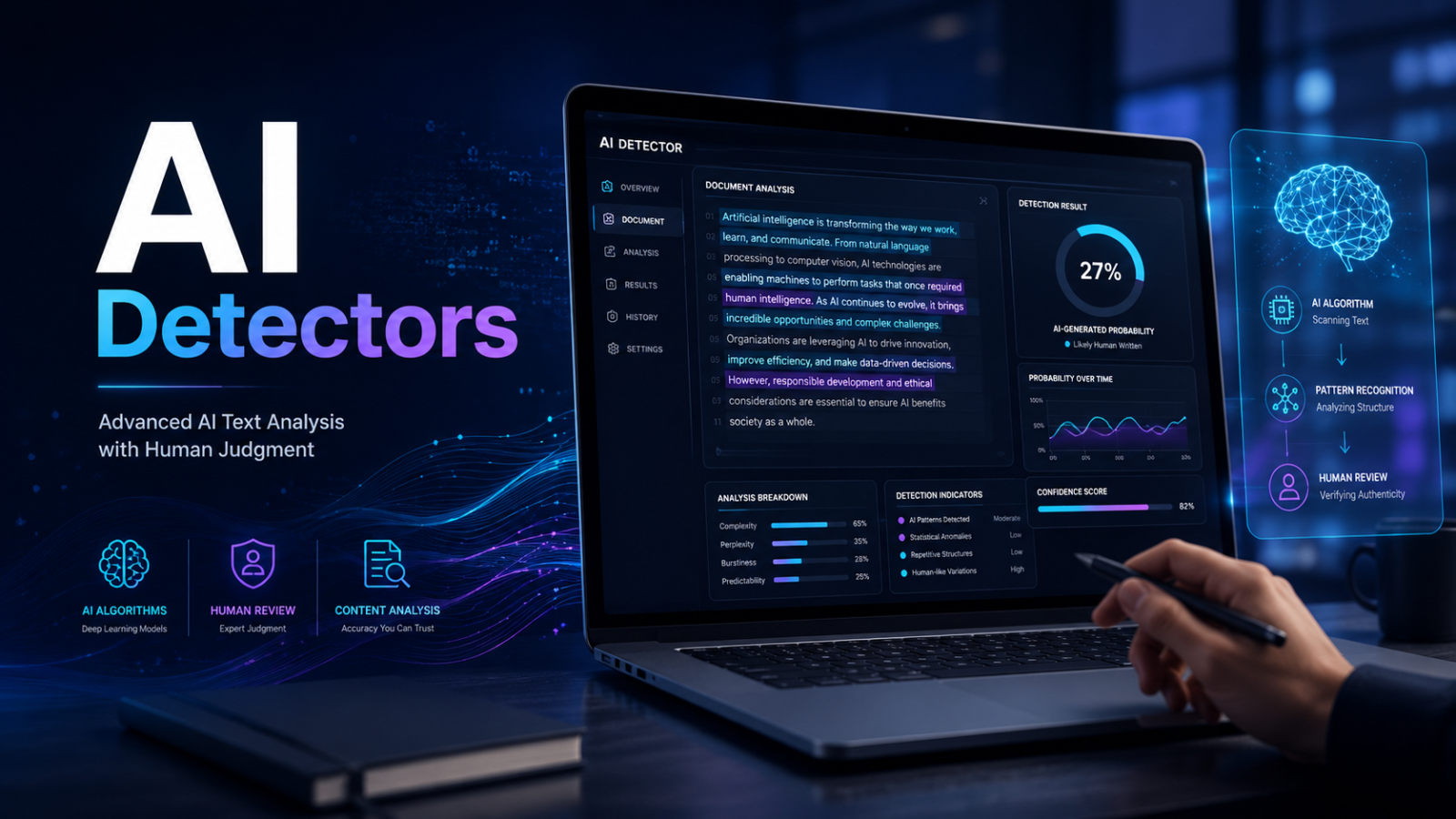
So here’s something worth thinking about. The internet feels different now. Not in a vague, hard-to-explain way either. Three years ago, nobody was stopping mid-read to wonder if a human actually wrote what they were looking at. Now that question pops up everywhere, in classrooms, newsrooms, offices, and comment sections.
AI detectors showed up as the answer to that. But do they actually work the way people think they do? And should you be putting that much trust in them? Honestly, it’s more complicated than a percentage score suggests, and we will find out exactly how in this blog.
What These Tools Are Actually Measuring
A language model doesn’t write the way a person does. It doesn’t get stuck, change its mind halfway through, or reach for a weird word because it just felt right. It moves forward by predicting what word most likely comes next, based on everything it was trained on. The output tends to be clean, structured, and notably consistent.
That consistency is the tell. And that’s what detectors are trained to find. Two things get measured most often:
- The first is bafflement, which is basically a measure of how predictable the word choices are. People write with a certain looseness. We go off on tangents, use phrases that don’t quite fit, and pick the slightly unusual word over the safe one. AI tends to stay closer to the expected path. The more predictable the text, the more the detector raises an eyebrow.
- The second is burstiness, which looks at sentence length variation. Read anything a real person wrote, and you’ll notice the rhythm shifts. Short sentence. Then one that goes on a bit longer and pulls in more detail before landing. Then maybe just a fragment. AI writing doesn’t do that as naturally. The lengths stay closer together, and the rhythm gets a little too even.
Put these two signals together, and you get a probability score. Which sounds more precise than it actually is.
How the Detection Actually Happens
Most detectors are machine learning models themselves. They’ve been trained on huge amounts of text, some confirmed human, some confirmed AI, and they’ve learned to tell the difference based on patterns most readers wouldn’t consciously notice.
Some systems take it further with watermarking, where certain patterns get baked into AI-generated text at the point of creation. It’s a more direct approach, and when it’s implemented well, it works better than guessing from statistics alone. A few major labs have been working on this, though it hasn’t become standard yet.
There’s also stylometric analysis, which goes after writing habits. How often passive voice shows up, how complex the vocabulary runs, and what the punctuation patterns look like. Writers develop fingerprints over time without realizing it. So do AI models, though their fingerprint tends to feel less like a person and more like a template.
The Part Nobody Talks About Enough
The false positive problem is genuinely serious. A student who writes carefully, especially someone working in a second language, can get flagged just for being thorough and formal. Someone producing NEBOSH assignment help material, for instance, is going to write in structured, technical language almost by definition. That’s what the subject demands. But a detector might read that same precision as suspicious.
On the other side, a heavily edited AI draft often gets through without any flags at all. Run something through a model, rewrite it enough, and the statistical traces mostly disappear. Domain-specific writing causes problems, too. Legal language, clinical documentation, and technical guides are all written to be exact and unemotional.
That’s not a sign of artificiality; that’s just what the format requires. Detectors don’t always know the difference. And the scores themselves aren’t consistent. Submit the same piece to three different detectors, and you might get three completely different readings. That alone should give pause to anyone treating these tools as final answers.
Where Human Judgment Fits In
A detector can raise a flag. It can’t tell you what the flag actually means.
That’s why the more thoughtful approach, whether in academic settings or editorial ones, pairs the tool with a real reader. Someone who can ask whether the writing reflects actual familiarity with the subject. Whether the perspective feels lived-in. Whether the argument does something a generic model wouldn’t bother doing.
The thought of “I just want someone to do my assignment for me” isn’t new. People have always looked for shortcuts. But experienced evaluators aren’t just running scans. They’re reading for the things that are genuinely hard to fake.
Conclusion
AI detectors are worth using. They’re just not worth over-relying on. They catch patterns, not intentions. They work better as one input among several than as a verdict on their own. The technology on both sides keeps moving. Better generation, better detection, back and forth. Neither has pulled far enough ahead to settle things. What stays constant is that real judgment, human and contextual, still does things a confidence score simply can’t.