
Ask a room full of drivers how a gasoline car refuels and you’ll get one bored answer. Ask how electrified cars get their energy and you’ll get five confident, contradictory ones. Some people believe every hybrid must be plugged in. Others think public fast chargers are the main way EV owners charge (they’re not — home charging covers 80–90% of sessions for most owners). And almost nobody can explain why the same car charges from 10% to 50% in twelve minutes but takes another forty to finish.
The energy side of electrified driving is genuinely different from anything the gas station taught us — part free energy recovered from braking, part overnight trickle, part high-voltage engineering sprint. Understand the full picture and you’ll charge cheaper, road-trip faster, and stop paying for confusion.
The Refueling Question Nobody Answers at the Dealership
Here’s the mental shift that makes everything else click: a gasoline car has one energy input. An electrified car can have up to four — regenerative braking, the engine acting as a generator (in hybrids), AC charging from a wall, and DC fast charging from high-power public equipment. Which inputs your car uses, and in what mix, defines your entire ownership experience far more than horsepower does.
A conventional hybrid uses only the first two and never touches a plug. A plug-in hybrid uses all four in small doses. A full EV skips the engine entirely and leans on the wall socket plus the occasional road-trip fast charge. Same badge on the grille sometimes; completely different daily rhythms.
The dealership rarely walks buyers through this because the honest answer — “it depends on where you sleep and how far you drive” — doesn’t fit a brochure. But it fits the rest of this article.
The Energy Your Brake Pedal Used to Throw Away
Every time a conventional car slows down, its kinetic energy converts to heat in the brake discs and radiates into the air. Gone. A car decelerating from highway speed dumps enough energy to run a household appliance for hours — and does it dozens of times per trip.
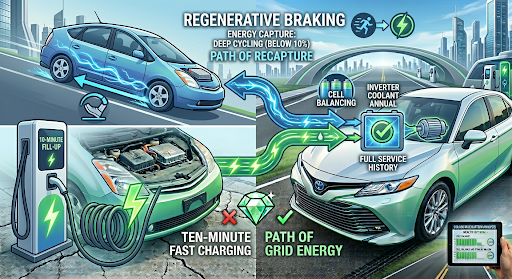
Electrified cars claw that energy back. Lift off the accelerator or press the brake, and the drive motor flips into generator mode, converting motion back into electricity and pushing it into the pack. Engineers call it regenerative braking; drivers mostly notice it as the car slowing more assertively when they lift off.
The recovery rates are better than most people guess. In city driving, regeneration typically returns 15–30% of the energy the car consumed, which is why electrified vehicles post their best efficiency in stop-and-go traffic — the exact conditions that murder gasoline mileage. It’s also why brake pads on these cars routinely last 80,000–150,000 km; the friction brakes spend most of their life as backup.
Two practical notes drivers learn the slow way. First, regeneration weakens when the pack is cold or nearly full — the car has nowhere to put the energy — so expect softer braking feel on frosty mornings and right after a full charge. Second, smooth anticipation beats hard braking: energy recovered gradually at moderate power regenerates more efficiently than a panic stop, which forces the friction brakes to handle the overflow.
The No-Plug Lifestyle: How Self-Charging Hybrids Pull It Off
Conventional hybrids occupy a spot that confuses new buyers every single day: an electric-assisted car you cannot plug in, ever. All of its electricity comes from regeneration and from the engine occasionally spinning the motor-generator, orchestrated by software making decisions dozens of times per second.
The engineering trick is keeping the pack tiny and the cycling shallow. A Prius hybrid battery holds only around 1 kWh — less than 2% of a long-range EV’s capacity — and the control software deliberately keeps it swinging between roughly 40% and 80% charge, a pampered duty cycle that’s the main reason these packs so routinely cross 300,000 km in taxi service. The pack isn’t there to store range; it’s there to let the engine shut off at lights, fill torque gaps, and bank braking energy for the next acceleration.
The payoff shows up at the pump rather than a plug: 40–55% better fuel economy than an equivalent gasoline car in city driving, with zero change to refueling habits. The limitation is equally clear — you’re still burning fuel for every kilometer, just less of it. For drivers without home charging access, that trade is often the rational one, which is why this “transitional” technology keeps outselling predictions of its death.
Home Charging: Boring, Slow, and Quietly the Whole Game
For plug-in vehicles, the least glamorous charging method does almost all the work. Level 1 charging — a standard household outlet — adds only 5–8 km of range per hour, which sounds useless until you multiply by twelve overnight hours and realize it covers a typical commute. Level 2 equipment (a 240V circuit, roughly $400–1,200 installed in most homes) delivers 30–60 km of range per hour and refills even a large pack overnight.
The economics are where home charging embarrasses every alternative. At average residential rates, electricity costs work out to the equivalent of paying $0.90–1.50 per gallon of gasoline; on off-peak or EV-specific utility plans, some owners drive for the equivalent of $0.50–0.80 per gallon. Public DC fast charging, by contrast, often costs three to five times the home rate — sometimes approaching gasoline-per-mile pricing.
That price gap creates the golden rule experienced owners live by: charge where you sleep, fast-charge only when you travel. It also explains the single most useful pre-purchase question for any plug-in vehicle: not “how fast does it charge?” but “where will it charge every night?” An apartment dweller with no overnight option faces a fundamentally different (and pricier) ownership than a homeowner with a garage outlet — sometimes different enough to make a no-plug hybrid the smarter pick.
Fast Charging’s Dirty Secret: The Curve
Public DC charging is where marketing numbers and physics part ways. A station’s “250 kW” rating and a car’s “18-minute charge” claim both describe peak moments, not the whole session — and the shape of the charging curve is what actually determines your road-trip rhythm.
Every pack charges fastest when it’s low and empty of resistance, then tapers as it fills — steeply after about 80%. A typical modern EV might accept 150–250 kW between 10% and 50%, half that by 70%, and a trickle beyond 90%. This is deliberate: cramming ions into nearly-full cells at high current risks lithium plating, so the battery management system throttles hard to protect the pack.
The practical playbook that falls out of this:
- Arrive low, leave at 80%. The 10–80% window is where fast charging earns its name. Charging 80–100% at a DC station often takes as long as 10–80% did — pure wasted road-trip time unless you truly need the buffer.
- Precondition on the way. Navigating to a charger in the car’s own system warms the pack to its happy temperature first; skipping this in cold weather can double your session time.
- Judge cars by the 10–80% minutes, not peak kW. A car holding 140 kW steadily across the window beats one that flashes 230 kW for two minutes and collapses.
The Ten-Minute Frontier: Refueling at Gasoline Speed
The industry’s next target has a formal name and a hard number: 80% charge in ten minutes or less, which requires sustained charging rates of 4–6C — filling the entire pack four to six times over per hour. That’s the threshold where plugging in stops feeling like an errand and starts feeling like a gas stop.
Getting there is a systems problem, not a single invention. An extreme fast charging battery needs anode materials that accept ions without plating (silicon blends and niobium-based designs lead here), electrolytes that stay stable under thermal stress, and cell formats that shed heat quickly — and it needs all of that paired with 800–900V vehicle architectures and grid connections powerful enough that a busy station can draw as much electricity as a small factory. The first production cells rated for roughly 10–15 minute fills began appearing in Chinese-market vehicles in 2023–2025, with charging networks racing to install the 350–500 kW hardware that can actually feed them.
The catch that headlines skip: extreme rates stress everything. Cells engineered for 5C charging typically sacrifice some energy density, cooling systems grow heavier and costlier, and repeated maximum-rate sessions still age a pack faster than gentle ones — physics grants no free lunches, only better-negotiated trades. For most drivers, the realistic near-term win isn’t ten-minute charges every day; it’s road trips where the charging stop finally matches the coffee stop.
Building Your Personal Charging Strategy in Five Steps
Theory into practice. Here’s how to set up refueling that costs the least and stresses the pack the least:
1. Audit your real daily distance. Not your longest imaginable day — your median one. Most drivers cover 30–60 km daily, which even Level 1 charging replaces overnight. Buying charging hardware for the 2% of days distorts the whole budget.
2. Solve the overnight question first. Garage or driveway: install Level 2 if your daily distance exceeds what Level 1 replaces. Renters: check for workplace charging, negotiate with landlords (dedicated 240V outlets are cheap upgrades), or map reliable curbside options before committing to a plug-dependent car.
3. Get on the right electricity tariff. Many utilities offer EV or time-of-use rates that cut overnight charging costs 30–60%. Schedule charging through the car or charger to hit the cheap window automatically. This one phone call often saves more than any driving technique.
4. Set a daily charge ceiling that matches your chemistry. Iron-phosphate packs: charge to 100% freely. High-nickel packs: set 80% as the daily limit and save full charges for trips. The setting takes thirty seconds and meaningfully slows aging.
5. Plan road trips around the curve, not the map. Two shorter 10–60% sessions usually beat one long 10–95% session. Route planners that account for your specific car’s curve (several good ones exist) turn this into a solved problem.
Refueling Myths That Drain Wallets
“Public fast charging is how EV owners charge.” It’s the exception, not the rule — home and workplace charging handle the overwhelming majority of energy for owners with overnight access. Judging EV ownership by fast-charger prices is like judging grocery costs by airport sandwiches.
“Hybrids need to be plugged in or the battery dies.” Conventional hybrids have no charge port at all; the car manages its small pack entirely on its own. The related myth — that the pack drains permanently if the car sits — only becomes a real concern after many months of storage.
“Regenerative braking can fully recharge the battery while driving.” It recovers a fraction of energy already spent accelerating; it can’t create net range on flat ground. The exception that proves the rule: descending a long mountain grade genuinely can add 5–15% charge.
“Charging to 100% every night keeps you ready and costs nothing.” For high-nickel chemistries, parking full every night measurably accelerates aging, and the ‘readiness’ buys range most days never use. Match the habit to the chemistry, not to gas-tank instincts.
“Cold weather charging damages the pack.” Charging in cold weather is fine — the car warms the pack first and throttles as needed. What harms cells is forcing high current into a frozen pack, which modern battery management simply refuses to do.
What a Kilometer Actually Costs, Input by Input
Strip everything down to per-100-km energy costs for a typical efficient vehicle, using broad current ranges:
- Gasoline (non-hybrid): $9–14 at typical fuel prices and 7–8 L/100 km consumption.
- Gasoline (conventional hybrid): $5.50–9 — the no-plug efficiency dividend.
- Home charging, standard rate: $2.50–4.50 for a full EV consuming 15–18 kWh/100 km.
- Home charging, off-peak EV tariff: $1.20–2.50 — the cheapest driving most people will ever do.
- Public DC fast charging: $6–12, occasionally more at premium networks — comparable to hybrid gasoline costs.
The pattern explains real owner behavior better than any survey: people with overnight charging drive on the cheapest energy available and rarely think about it; people relying on public fast charging pay hybrid-gasoline prices with extra planning attached. The vehicle matters less than the match between the vehicle and your access to a plug.
The One Question That Sorts Everything
Every choice in this article — hybrid or plug-in, Level 1 or Level 2, which chemistry, which road-trip rhythm — collapses into a single question: where will this car get its energy on an ordinary Tuesday? Answer that honestly and the right vehicle, hardware, and habits mostly choose themselves. Skip it and you’ll either overpay for charging you don’t have access to or under-buy the setup your driving genuinely needs.
The refueling revolution isn’t really about ten-minute miracles or exotic chemistry. It’s about energy quietly arriving while you sleep, brake, and drink coffee — as long as you set the system up once, correctly, and then let it be boring. Boring, in this corner of driving, is exactly what winning looks like.
Frequently Asked Questions
Can I use a regular household outlet to charge a plug-in car? Yes — every plug-in vehicle ships with or supports a portable Level 1 cable for standard outlets. It adds only 5–8 km of range per hour, but overnight that covers a typical commute. Just have an electrician confirm the circuit is in good condition for continuous load.
How much does home charging equipment cost to install? Level 2 hardware runs $300–700, with installation typically $200–800 depending on panel distance and capacity — call it $400–1,200 all-in for most homes. Many utilities and regions offer rebates that cover a meaningful chunk.
Why does the last 20% of charge take so long at public stations? The battery management system deliberately slows current as cells fill to prevent lithium plating and heat buildup. It’s protection, not malfunction. On road trips, unplugging at 80% and driving on is almost always faster overall.
Does regenerative braking work in every situation? It weakens when the pack is cold or nearly full, and the friction brakes cover the difference automatically. Drivers mostly notice softer deceleration on winter mornings or right after a full charge — normal behavior, not a fault.
Is it cheaper to run a plug-in car than a gasoline one? With home charging, dramatically — energy costs typically fall 50–75% versus gasoline, plus lower maintenance. Relying mainly on public fast charging shrinks the gap to modest or nil, which is why overnight charging access is the deciding factor.
Do frequent rapid-charge sessions shorten pack life? They add modest extra wear — measurable in fleet studies, but far smaller than heat exposure or chronic full-charge parking. Occasional road-trip use is a non-issue; daily reliance on maximum-rate sessions is where the extra aging accumulates.
What happens if a hybrid’s high-voltage pack eventually wears out? The car typically still drives but with worse fuel economy and warning lights, not a sudden stop. Refurbished and aftermarket replacements from independent shops now cost a fraction of old dealer quotes, and the repair market for popular models is mature and competitive.