
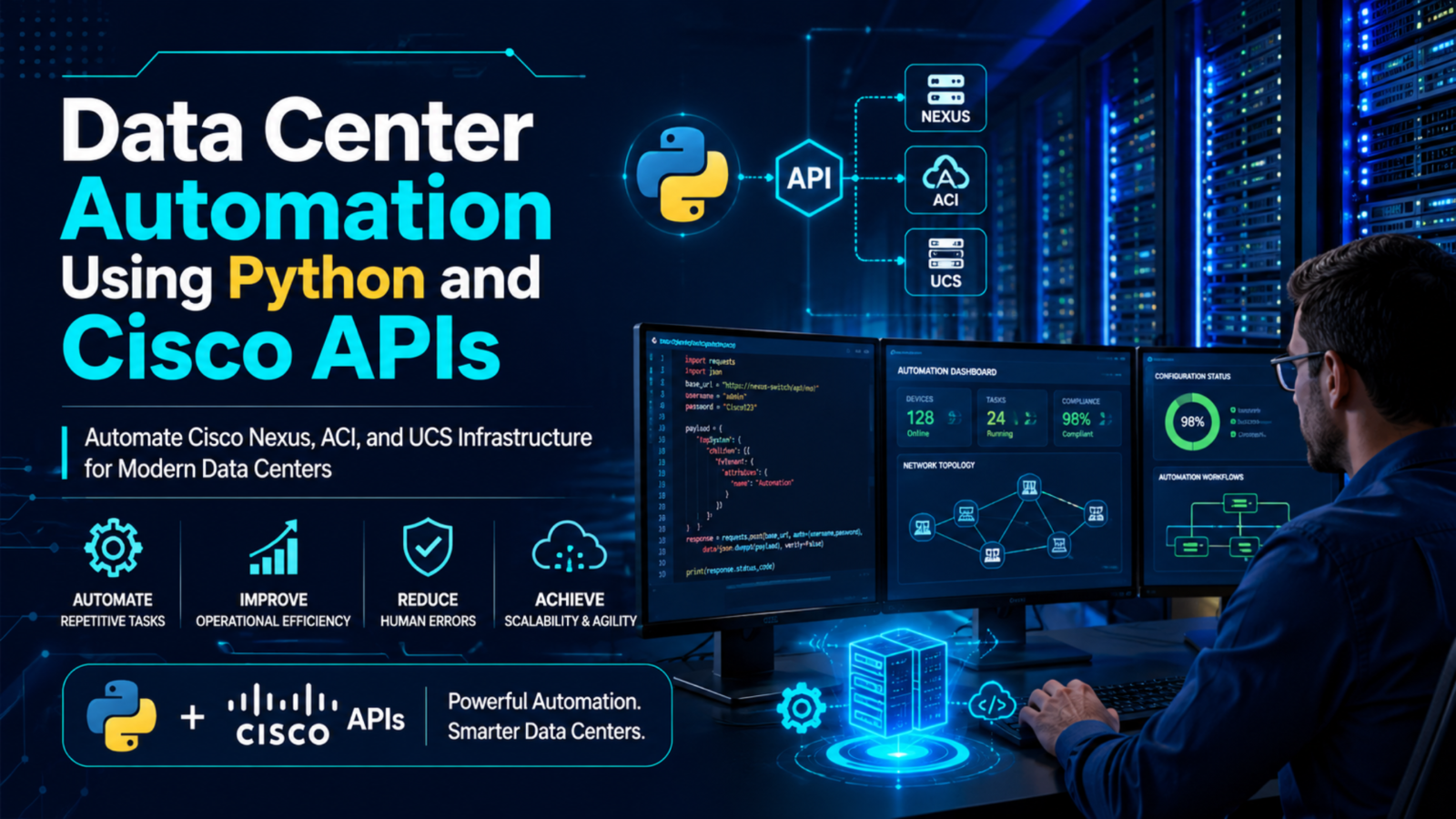
Data Center Automation Using Python and Cisco APIs is transforming how modern organizations manage, monitor, and scale their data center infrastructure. As enterprises continue to adopt cloud technologies, virtualization, and software-defined networking, automation has become a critical component of efficient IT operations. Network engineers and infrastructure professionals who want to pursue CCIE Data Center training should develop a strong understanding of automation tools and programmable network technologies, as these skills are increasingly required in enterprise environments.
Python scripting and Cisco APIs enable faster configuration, streamlined operations, reduced manual effort, and improved consistency across complex infrastructures. This guide explores the fundamentals, benefits, and practical applications of data center automation in today’s evolving technology landscape.
What Is Data Center Automation?
Data center automation refers to the use of software tools, scripts, and APIs to automate routine infrastructure tasks that were traditionally performed manually. These tasks may include:
- Device configuration
- Network provisioning
- Monitoring and troubleshooting
- Policy deployment
- Software upgrades
- Security compliance checks
- Resource management
Automation helps organizations achieve consistency, speed, and accuracy while reducing the risk of configuration errors.
Why Data Center Automation Matters
Traditional data centers often rely on manual processes that consume time and introduce operational risks. As businesses scale their IT infrastructure, managing hundreds or thousands of devices manually becomes increasingly difficult.
The following are some major advantages of data center automation:
Faster Deployment
Automated workflows can provision network devices and services in minutes instead of hours.
Reduced Human Errors
Automation eliminates repetitive manual tasks that often lead to configuration mistakes.
Improved Consistency
Standardized configurations ensure that all devices follow organizational policies.
Better Scalability
Large-scale infrastructures can be managed efficiently without increasing operational complexity.
Enhanced Security
Automated compliance checks help identify vulnerabilities and policy violations.
Data Center Automation and Python’s Function
Python has emerged as the preferred programming language for network and data center automation due to its simplicity, readability, and extensive ecosystem.
Network engineers can use Python to:
- Automate repetitive tasks
- Interact with APIs
- Collect device information
- Generate reports
- Manage configurations
- Perform network validation
Python’s extensive libraries make it easier to communicate with networking devices and automation platforms.
Popular Python libraries include:
- Requests
- Netmiko
- Paramiko
- NAPALM
- PyATS
- Pandas
These libraries simplify automation workflows and accelerate deployment processes.
Understanding Cisco APIs
An API (Application Programming Interface) enables software applications to communicate with network devices and management platforms.
Cisco provides a wide range of APIs that allow engineers to automate network operations without manually accessing devices.
Some commonly used Cisco APIs include:
Cisco NX-API
Cisco NX-API enables programmatic access to Cisco Nexus switches.
It supports:
- Configuration management
- Operational data retrieval
- Monitoring and troubleshooting
Cisco UCS API
Cisco Unified Computing System (UCS) APIs help automate server and compute infrastructure management.
Capabilities include:
- Server provisioning
- Resource monitoring
- Policy management
Cisco ACI REST API
Cisco Application Centric Infrastructure (ACI) provides powerful REST APIs for automating application-centric networking tasks.
Common use cases include:
- Tenant creation
- Policy deployment
- Endpoint monitoring
- Network segmentation
Cisco DNA Center APIs
These APIs enable centralized automation and management across enterprise and data center networks.
Python and Cisco APIs: A Powerful Combination
When Python interacts with Cisco APIs, engineers can automate complex workflows with minimal effort.
For example, a Python script can:
- Connect to Cisco Nexus devices.
- Retrieve interface status.
- Identify inactive ports.
- Generate a report.
- Send alerts automatically.
Instead of manually checking each device, engineers can execute a script and obtain results within seconds.
Common Data Center Automation Use Cases
Network Configuration Automation
Python scripts can deploy standardized configurations across multiple devices simultaneously.
Benefits include:
- Faster deployment
- Reduced configuration drift
- Improved compliance
Device Inventory Management
Automation can collect information such as:
- Device models
- Serial numbers
- Software versions
- Interface details
This data can be stored and analyzed automatically.
Network Health Monitoring
Automated monitoring solutions continuously collect performance metrics and alert administrators when issues arise.
Examples include:
- CPU utilization
- Memory consumption
- Interface errors
- Link failures
Software Upgrade Automation
Large organizations often manage hundreds of devices.
Automation can streamline:
- Image validation
- Upgrade scheduling
- Configuration backups
- Post-upgrade verification
Compliance and Security Audits
Python scripts can compare device configurations against predefined security policies and identify non-compliant devices.
Data Center Automation Tools and Their Functions
| Tool/Technology | Primary Purpose | Typical Use Case |
| Python | Automation scripting | Device management and reporting |
| Cisco NX-API | Nexus switch automation | Configuration and monitoring |
| Cisco UCS API | Server automation | Compute resource management |
| Cisco ACI API | Policy-based networking | Tenant and application deployment |
| Netmiko | Device connectivity | CLI automation |
| NAPALM | Multi-vendor automation | Configuration management |
| PyATS | Network testing | Validation and troubleshooting |
| Ansible | Agentless automation | Large-scale orchestration |
Getting Started with Python-Based Automation
Beginners can follow these steps:
Step 1: Learn Python Fundamentals
Focus on:
- Variables
- Loops
- Functions
- Dictionaries
- JSON
- Error handling
Step 2: Understand REST APIs
Learn how APIs work, including:
- HTTP methods
- Authentication
- JSON responses
- API requests
Step 3: Explore Cisco Developer Resources
Cisco provides extensive documentation and sandbox environments for learning automation.
Step 4: Build Small Automation Projects
Examples include:
- Interface status collection
- Device inventory reports
- Configuration backups
Step 5: Expand to Enterprise Workflows
Once comfortable, engineers can automate:
- Data center provisioning
- Security policies
- Monitoring systems
- Multi-device orchestration
Challenges in Data Center Automation
Although automation offers significant benefits, organizations may face several challenges.
Skill Gaps
Many network professionals have strong networking knowledge but limited programming experience.
Legacy Infrastructure
Older devices may not fully support modern APIs.
Security Considerations
Automation systems require proper authentication, authorization, and access controls.
Change Management
Organizations must carefully validate automation workflows before deployment in production environments.
Best Practices for Successful Automation
To maximize success, organizations should follow these guidelines:
Start Small
Begin with low-risk automation projects before automating mission-critical services.
Use Version Control
Tools like Git help manage automation scripts and track changes.
Document Everything
Maintain clear documentation for workflows, scripts, and operational procedures.
Implement Testing
Validate automation scripts in lab environments before production deployment.
Monitor Automation Outcomes
Continuously review results to ensure workflows operate as expected.
Future of Data Center Automation
The future of data center operations is increasingly driven by automation, artificial intelligence, and intent-based networking.
Emerging technologies are enabling:
- Self-healing networks
- Predictive analytics
- AI-driven operations
- Automated security responses
- Autonomous infrastructure management
As organizations continue their digital transformation initiatives, automation skills will become even more valuable for networking professionals.
Conclusion
Automation using Python and Cisco APIs is no longer optional for modern data center professionals; it has become a fundamental skill for building efficient, scalable, and reliable infrastructure. Organizations increasingly rely on automation to accelerate deployments, reduce operational costs, minimize configuration errors, and improve overall network performance.
As data centers continue to evolve with technologies such as Cisco ACI, Nexus, and UCS, engineers who can leverage Python and APIs gain a significant competitive advantage in the job market. For professionals who want to pursue a CCIE Data Center Course, developing strong automation skills can enhance both exam preparation and real-world expertise. By combining deep networking knowledge with automation capabilities, engineers can future-proof their careers and confidently manage next-generation data center environments.