
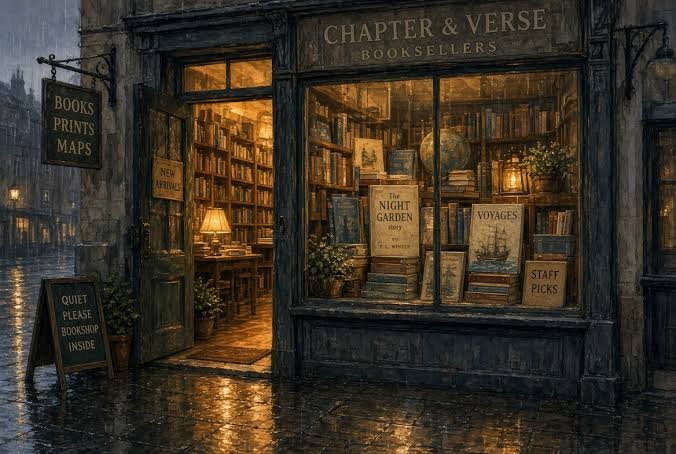
A local bookshop does not need a blockbuster trailer to announce a small evening event. A window, a chair, and a few carefully chosen books can suggest the atmosphere more clearly than a busy poster animated in every direction. If I were planning a promotional concept for an imaginary reading night, I would start with the feeling of arriving just before the doors open.
The project would be fictional, with no invented attendance figures or claim that an event has already happened. I would picture a neighborhood shop preparing for a relaxed evening of stories. The video would move from the window to a reading chair, then finish on a simple invitation. Actual dates, venue details, and booking instructions would be supplied and checked by the organizer before any real publication.
I would make the visual sequence quiet enough to suit the setting. A reflection shifting across the window could open the scene. A lamp beside the chair could provide the second moment. The closing image might show an open book with no readable text, leaving space for the event details added later. Each shot would communicate readiness without pretending to show a real audience.
Before choosing a tool, I would write down what the video needs to accomplish: introduce the mood, make the shop feel welcoming, and leave enough time for the invitation. It would not need a fictional celebrity endorsement or a generated crowd. Those additions could make a modest local event look misleadingly grand and distract from the practical information viewers need.
That brief would guide my exploration of Seedance 3.0, an AI video model supporting text-to-video, image-to-video, and reference-based generation. Text, images, video, and audio can be combined as references for a scene. I would use those capabilities to develop illustrative promotional clips, while keeping the event’s factual details and final arrangement under direct editorial control.
Collect a few references with clear purposes
If this became a real project, I would ask the shop for permission to use photographs of its window and reading area. I would choose images without customer faces or private paperwork. One photograph would establish the location’s colors and layout. Another would show the chair and lamp. A short camera reference could demonstrate the pace of the movement rather than dictate every object in the frame.
My Seedance 3.0 instructions would separate those roles. The window photograph would guide the architecture; the close-up would guide materials; the movement clip would guide a slow approach. I would not expect the model to infer that hierarchy from a folder of unrelated pictures. A compact reference set would also make it easier to identify why a generated scene differs from the intended shop.
Write the opening around one visible change
The opening prompt for Seedance 3.0 would describe a small bookshop window at early evening, warm light inside, and a gentle camera movement toward the glass. I would keep the signage blank or out of focus, then add verified branding separately if appropriate. Asking a generated scene to reproduce a logo and event text exactly would introduce avoidable errors into the part of the video that must be reliable.
I would judge the first Seedance 3.0 result by the window’s stability, the reflections, and the pace of the camera. If shelves appeared to move behind the glass, I would shorten the shot or simplify the composition. A clean view of one welcoming detail would be more useful than a sweeping shot full of unstable objects.
Let the room imply an event without fabricating one
The next clip would show the empty reading chair and a lamp. I would avoid generating a speaker who could be mistaken for a real author or a crowd that suggests attendance. An empty, prepared space can communicate anticipation honestly. If the organizer wanted footage of an actual guest, that material would need to come from an authorized real recording.
For the chair scene in Seedance 3.0, I would keep the camera steady and give the light a clear direction. The book on the side table could remain closed. The point would be the arrangement of the space, not a complicated action involving hands and pages. I would choose a composition with room for a short caption without covering the chair itself.
Make the invitation readable in the edit
I would add the event name, date, time, and location as editable text after selecting the clips. This would let the organizer correct a detail without regenerating the visual background. I would check every line against the approved event information. If a booking address or QR code were included, I would test it in the finished export rather than assume it remains usable after compression.
The invitation would have its own pause. A viewer should not need to replay the video several times to catch the time or venue. I would use a plain typeface and a calm background, with enough contrast for a small phone screen. The video’s atmosphere would attract attention, but the practical details would determine whether that attention can turn into a visit.
Use audio as a mood reference, then listen carefully
A quiet instrumental phrase or a little room ambience could support the concept. I would use material the shop owns or has permission to adapt. If an audio reference shaped a generated clip, I would still review the result for timing and distracting sounds. I would not imply that a famous musician or author contributed to the event unless that were actually true.
The Seedance 3.0 sequence would also need to work without sound. I would watch a muted version to check whether the movement, captions, and final invitation remain clear. If a voiceover carries important information, captions would repeat it. This would make the video more useful in a social feed where viewers often decide whether to continue before enabling audio.
Review the finished concept as a local invitation
My final pass would check object continuity, readable text, correct event details, and a truthful description of the visuals. I would label the generated scenes as an AI-created promotional concept where needed. If the imagery resembles the real shop, I would make sure it does not suggest changes to the premises or facilities that do not exist.
For a project like this, Seedance 3.0 would help me explore how a small place can feel in motion. The strongest result would not be the busiest one. It would be a short, coherent invitation that preserves the character of the bookshop, gives the organizer room to state the facts, and lets a viewer imagine arriving for a pleasant evening.