
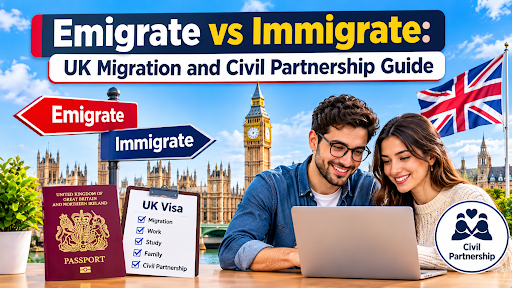
Moving to another country is a significant decision that can affect an individual’s career, family life, relationships and future opportunities. Whether someone plans to relocate permanently, join a partner or explore better employment prospects, understanding immigration terminology and legal requirements is essential. One common source of confusion is emigrate vs immigrate, as these terms describe different perspectives of the same international movement. Understanding the distinction can help individuals communicate their relocation plans accurately and learn more about the legal procedures involved. For people considering a move to the United Kingdom, it is also important to understand the immigration routes available, the documentation required and how family relationships may influence their eligibility to live in the country.
Understanding Migration and International Relocation
Migration refers to the movement of individuals from one geographical location to another. This movement may happen within the same country or across international borders. People migrate for various reasons, including employment, education, family reunification, safety and improved living conditions.
International migration has become an important part of modern society. People regularly relocate to different countries to pursue professional opportunities, establish businesses, study at universities or build a life with their partners.
Although migration is a general term, several related words describe different aspects of the relocation process.
What Does Migration Mean?
Migration is the broad term used to describe movement from one place to another. It does not necessarily indicate whether someone is leaving a country or entering a new one.
For example, a person moving from India to the United Kingdom is considered a migrant from the perspective of the overall movement.
Migration can be temporary or permanent, depending on the individual’s circumstances and intentions.
Some people migrate for a short period to complete university studies or undertake employment contracts. Others relocate permanently because they want to establish long-term residence in another country.
What Is Emigration?
Emigration describes the act of leaving one’s home country to live in another country.
For example, someone who leaves the United Kingdom to settle in Canada is emigrating from the UK.
People may decide to emigrate because of:
- Better employment opportunities.
- Family or relationship commitments.
- Educational opportunities.
- Business and investment prospects.
- Lifestyle preferences.
- Political or economic circumstances.
- Personal development and new experiences.
Emigration involves planning and preparation, particularly when individuals intend to relocate permanently. They may need to consider tax responsibilities, property arrangements, employment contracts, healthcare access and the immigration rules of their destination country.
What Is Immigration?
Immigration describes entering another country with the intention of living there, either temporarily or permanently.
For example, someone moving from Australia to settle in Britain is immigrating to the UK.
Immigration requirements depend on the destination country and the individual’s circumstances. A person may need a work visa, student visa, family visa or another form of immigration permission. The UK immigration system has different routes for people seeking to work, study, join relatives or establish long-term residence. Applicants should identify the correct category before making arrangements because each route has specific eligibility conditions.
Why Do People Choose to Move to the United Kingdom?
The United Kingdom remains an attractive destination for international migrants for several reasons. Its economy, educational institutions, employment opportunities and multicultural communities attract individuals from different parts of the world.
Employment Opportunities
Many international professionals move to Britain to pursue careers in healthcare, engineering, technology, finance, education and other industries. The Skilled Worker route allows eligible overseas professionals to work for approved UK employers when they satisfy the applicable requirements. Applicants generally need an eligible job offer, an approved sponsor and the relevant salary and other eligibility conditions.
Education and Professional Development
British universities and educational institutions attract students from around the world. International students may apply through the Student visa route if they have been accepted onto an eligible course by a licensed student sponsor and satisfy the relevant financial and other requirements. Studying in the UK can also provide opportunities to develop professional skills and establish international connections.
Family Reunification
Another important reason for migration is family reunification.
Individuals may want to relocate because their spouse, civil partner, parent or another qualifying family member lives in Britain.
Depending on the circumstances, a family immigration route may provide an opportunity to join relatives and establish a household in the UK.
Lifestyle and Personal Circumstances
Some people move because they prefer the UK’s cultural environment, public services, geographical location or lifestyle.
However, relocating internationally requires more than choosing a preferred destination. Individuals must understand the immigration conditions, financial commitments and responsibilities associated with living abroad.
Understanding Civil Partnerships and Their Legal Importance
Relationships are another significant reason why individuals consider relocating to the United Kingdom. Couples may want to live together, formalise their relationship or join a partner who already has permission to reside in Britain.
Before making immigration arrangements, it is important to understand the legal status of the relationship.
People researching what is a civil partnership should understand that it is a legally recognised relationship between two people who formally register their partnership under the applicable law.
In the UK, civil partnerships provide a legal framework for couples who want formal recognition of their relationship without entering into marriage.
Civil partnerships were originally introduced in 2004 for same-sex couples. The law was subsequently changed to allow opposite-sex couples to enter into civil partnerships as well.
This means that eligible couples of the same sex or opposite sex can register a civil partnership in the UK.
How Does a Civil Partnership Work?
A civil partnership is established through a formal registration process.
In England and Wales, the couple generally needs to give notice at a register office before the registration can take place.
The registration involves signing the relevant civil partnership document in the presence of a registrar and two witnesses.
Scotland and Northern Ireland have their own procedures, although the overall purpose is similar.
Once registered, the relationship receives legal recognition under the relevant legislation.
A civil partnership is not simply an informal agreement between two people. It creates a legally recognised relationship with important rights and responsibilities.
Who Can Enter Into a Civil Partnership?
Generally, two people can enter into a civil partnership if they satisfy the relevant legal conditions.
These include:
- Both individuals must meet the minimum legal age requirement, generally 18.
- Neither person can already be married or in another civil partnership.
- They must not fall within prohibited degrees of relationship.
- Both individuals must have the legal capacity to enter into the partnership.
- They must follow the applicable registration procedure.
Additional requirements may apply depending on nationality, immigration status and the location where the registration takes place.
Foreign nationals should check whether they need to provide additional documents or evidence of freedom to enter into a civil partnership.
Civil Partnerships and UK Immigration Applications
A legally recognised civil partnership can be relevant when someone applies to join their partner in the United Kingdom.
Under the UK family immigration system, eligible civil partners may be able to apply through the partner or spouse route.
However, having a civil partnership certificate does not automatically guarantee immigration permission.
Applicants must satisfy the relevant requirements under Appendix FM and provide the necessary evidence.
Partner Visa Eligibility
A person applying to join their civil partner in the UK will generally need to demonstrate that:
- Their relationship is legally recognised.
- The relationship is genuine and continuing.
- The sponsoring partner meets the relevant immigration status requirements.
- The financial requirements are satisfied, where applicable.
- Suitable accommodation is available.
- The applicant meets any applicable English language requirements.
The exact conditions depend on the application and the circumstances of both partners.
Proving a Genuine Relationship
Immigration authorities need to establish that a relationship is genuine and subsisting.
A civil partnership certificate is important evidence of the legal relationship, but additional documentation may be relevant.
Examples include:
- Photographs showing the couple together.
- Evidence of shared accommodation.
- Joint financial documents.
- Travel records.
- Communication history.
- Evidence of shared responsibilities.
- Correspondence addressed to both partners.
Not every applicant will have identical evidence. The documents should reflect the couple’s actual circumstances.
For example, couples who have lived in different countries may have fewer joint household documents. They may instead provide travel records, communication evidence and details explaining how they have maintained their relationship.
Financial Requirements for UK Partner Applications
Financial eligibility is an important consideration for people applying through the family route.
Under the standard financial requirement for many new spouse and partner applications, the sponsoring partner generally needs to demonstrate an annual income of at least £29,000.
However, different rules, exceptions and transitional arrangements may apply depending on when and how an application is made.
Financial evidence may include:
Employment Income: Payslips, bank statements and an employer’s confirmation letter can be required.
Self-Employment: Business accounts, tax documents and other relevant financial records may be necessary.
Cash Savings: Applicants relying on savings must demonstrate that they satisfy the applicable amount, ownership and holding-period requirements.
Other Permitted Sources: Certain additional income sources may be considered under the immigration rules.
Applicants should review the relevant financial provisions before submitting an application because incomplete evidence can create difficulties.
Documents Required for Civil Partnership and Immigration Applications
Preparing the correct documents is essential when formalising a relationship or applying for immigration permission.
Depending on the circumstances, couples may need the following:
Identity Documents
Both partners may need valid passports, proof of identity and other relevant personal records.
Civil Partnership Documentation
A civil partnership certificate is important evidence that the relationship has been legally registered.
Previous Relationship Documents
If either partner was previously married or in a civil partnership, evidence that the previous relationship has legally ended may be required.
Financial Records
Applicants should prepare the relevant payslips, bank statements, employment documents or savings evidence.
Accommodation Information
Evidence about the proposed UK address may be required, depending on the immigration route.
English Language Evidence
Applicants may need to demonstrate their English language ability through an approved test or another accepted form of evidence, unless an exemption applies.
Translations
Documents that are not in English or Welsh may need certified translations that meet the relevant immigration requirements.
Organising these documents before completing an application can make the process easier to manage.
Moving to the UK: Common Immigration Challenges
Relocating to another country can involve several administrative and legal challenges.
Understanding common difficulties can help applicants prepare more effectively.
Choosing the Wrong Immigration Route
Some individuals assume that every person with a British partner can automatically apply for a spouse visa.
However, the correct route depends on whether the couple is married, in a civil partnership, engaged or in an eligible unmarried relationship.
Selecting the appropriate category is essential.
Incomplete Relationship Evidence
A certificate alone may not provide all the evidence required to establish the circumstances of a relationship.
Applicants should check the relevant evidential requirements and prepare appropriate supporting documents.
Financial Eligibility Problems
Applicants may encounter difficulties if their financial evidence does not meet the specified requirements.
For example, payslips and bank statements may need to cover particular periods and correspond with one another.
Previous Immigration Issues
Previous refusals, overstaying or other immigration problems may be relevant to a new application.
Applicants should provide accurate information about their immigration history and seek appropriate advice if their circumstances are complicated.
Incorrect Personal Information
Differences between passport details, application forms and supporting documents can create unnecessary complications.
All personal information should be reviewed carefully before submission.
Practical Steps Before Emigrating to the UK
Moving internationally requires preparation in several areas.
People planning to relocate should consider the following steps.
Step 1: Establish Your Reason for Moving
Determine whether the purpose is employment, education, family reunification or another permitted reason.
Step 2: Research Immigration Options
Identify the visa category that matches your circumstances and review its eligibility requirements.
Step 3: Review Your Relationship Status
If you are relocating to join a partner, establish whether your relationship is a marriage, civil partnership or another recognised relationship.
Step 4: Prepare Financial Evidence
Understand the financial requirements and organise the relevant records.
Step 5: Check Your Travel Documents
Ensure that your passport and other identity documents are valid and that any required translations are available.
Step 6: Arrange Accommodation
Consider where you will live after arriving in Britain and prepare any relevant documentation.
Step 7: Obtain Professional Advice Where Necessary
If your situation involves complicated relationship, nationality or immigration issues, qualified advice may help you understand your options.
Frequently Asked Questions
What is the difference between emigration and immigration?
Emigration means leaving your home country to live elsewhere, whereas immigration means entering another country to establish residence. Both terms describe the same international movement from different perspectives.
Is migration the same as immigration?
No. Migration is the broader term for moving between locations. Immigration specifically describes entering another country to live there.
Can opposite-sex couples enter into civil partnerships in the UK?
Yes. Opposite-sex couples have been able to register civil partnerships in the UK following legislative changes introduced from 2019 onwards.
Does a civil partnership provide the same immigration rights as marriage?
Civil partners are recognised under the UK family immigration rules in a similar way to spouses, provided they satisfy the relevant requirements. However, immigration permission is not automatic.
Can I enter a civil partnership while living outside the UK?
There are circumstances in which civil partnerships or overseas relationships can be legally recognised under UK law. The available procedures depend on the country and the applicable legislation.
Can my civil partner sponsor me to move to Britain?
An eligible civil partner may be able to sponsor a family visa application if they meet the relevant immigration and financial conditions.
How long does a UK partner visa take?
Processing times depend on whether the application is made inside or outside the UK, the service selected and whether additional checks are necessary. Applicants should check the latest official guidance.
Conclusion
Moving to another country is a major life decision that requires careful planning and an understanding of immigration legislation. Knowing the differences between migration, emigration and immigration helps individuals understand the terminology used throughout international relocation procedures.
For people planning to establish a life in the United Kingdom with their partners, understanding civil partnerships is equally important. A civil partnership provides legal recognition of a relationship and may form the basis of an eligible family immigration application.
However, applicants must still satisfy the relevant legal, financial and evidential requirements. Preparing accurate documentation, understanding the correct immigration route and reviewing eligibility conditions can help make the process more organised.
Whether someone is relocating for employment, education or family reasons, researching the available options before making important decisions can help them approach their move to the UK with greater confidence.