
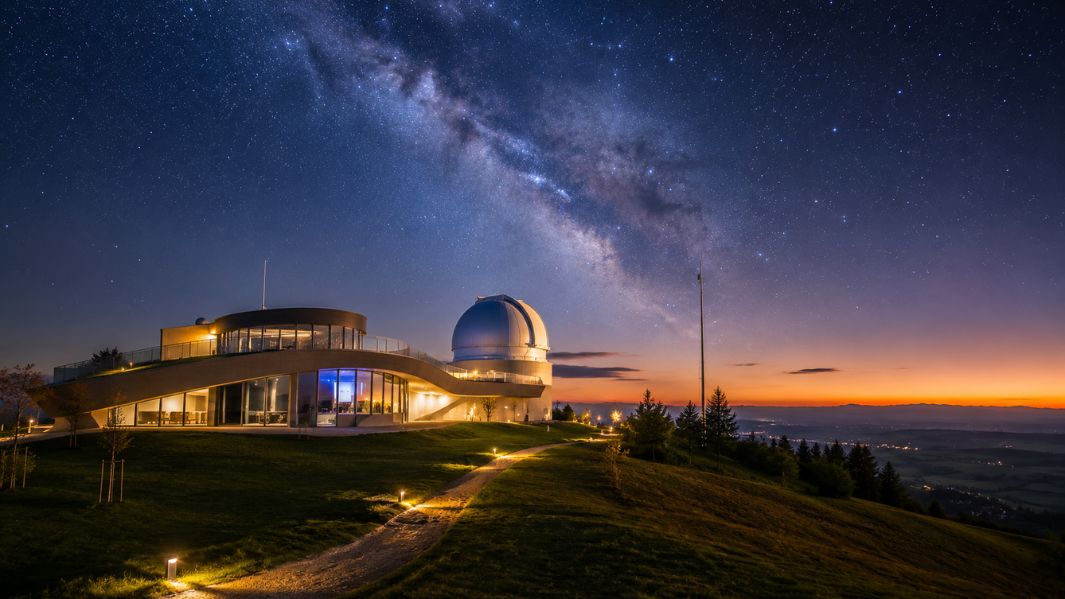
Uecht is more than just a place name; it represents an inspiring intersection of astronomy, Swiss landscapes, science education, and meaningful travel. Known for the historic Uecht Observatory and the modern Space Eye centre in Niedermuhlern, Canton of Bern, Switzerland, Uecht has evolved into a destination where visitors actively engage with the universe and the natural environment. Unlike destinations focused solely on scenery, Uecht sharpens its main message: the fusion of natural beauty and scientific knowledge creates a uniquely impactful experience.
What is Uecht?
Uecht is best understood as a place name associated with the elevated area near Niedermuhlern, south of Bern, where astronomy has played an important role for decades. The area is known for the Uecht Observatory, formerly known as Sternwarte Uecht, which was founded in the twentieth century and became an important private observatory associated with public interest in the night sky. Today, the name is even more visible because of Space Eye, officially presented as an observatory for space and the environment. This modern centre has given Uecht a new identity, not only as a quiet Swiss hilltop but also as a place where science is made understandable for families, students, tourists, astronomy lovers and curious visitors. When people search for Uecht today, they are usually looking for information about the observatory, its location, its history, and what makes the Space Eye centre special.
The Location of Uecht in Switzerland
The location of Uecht is one of the main reasons it feels so distinctive. It lies in the municipality of Niedermuhlern in the Canton of Bern, on the Längenberg hill range. This area offers a peaceful rural setting while remaining close enough to Bern to attract visitors from the city and the surrounding region. The elevated position makes it well-suited for observing the sky, offering a broader horizon and a calmer atmosphere than in a dense urban environment. Visitors arriving in the area experience more than a building or an exhibition space; they experience a Swiss landscape shaped by fields, hills, paths and open views. This combination of accessibility and countryside calm helps make Uecht a meaningful place for both educational visits and quiet reflection.
Uecht Observatory and Its Historical Importance
The history of Uecht Observatory gives the location much of its identity. The observatory was established in 1951 and became known as a place where astronomy could be explored outside a major city setting. It was connected with Willy Schaerer, a Swiss figure remembered for his passion for astronomy, and over time, the site developed a respected role in local astronomical culture. While it was not a giant international observatory like those found on remote mountaintops, its importance came from its educational value, its connection with dedicated observers, and its contribution to public interest in the sky. For many years, the observatory helped keep astronomy visible in the Bern region and created a foundation for the much larger Space Eye project that exists today.
From Historic Observatory to Space Eye
The transformation from the historic Uecht Observatory to Space Eye represents a major step in how scientific places can serve the public. Rather than remaining only a traditional observatory, the site expanded into a broader centre for space, environment and education. Space Eye opened to the public in 2023 and was developed in collaboration with the Stiftung Sternwarte Uecht, the University of Bern, and other partners. This development made the location more accessible to modern audiences by adding interactive exhibitions, a high-quality planetarium experience, educational programming, and public viewing opportunities through a powerful telescope. In this way, Uecht did not lose its astronomical roots; it built on them and became more relevant to the present day.
Space Eye: A Modern Centre for Astronomy and Environment
Space Eye is today’s main reason Uecht is widely searched. It is more than an observatory; it is an experience centre for astronomy and the environment. Its mission: help visitors understand the universe while reflecting on Earth, sustainability, and the role of technology in observing our planet. Space science encompasses not just distant galaxies but also satellites, climate awareness, communication, navigation, and humanity’s place in the cosmos. Space Eye connects wonder and education, letting visitors enjoy astronomy’s beauty while understanding its real-world impact.
The 8K Planetarium Experience
One of the standout features associated with Uecht today is the 8K planetarium at Space Eye. A planetarium allows visitors to experience the night sky, planets, galaxies and cosmic journeys in a controlled indoor environment. This is especially valuable because real sky observation depends heavily on weather, clouds, visibility and time of day. A high-quality planetarium can create an immersive learning experience even when outdoor conditions are not ideal. For families and students, it can be an exciting introduction to astronomy by turning complex scientific topics into something visual and memorable. The planetarium experience helps make Uecht more than a place for experts; it becomes a gateway for beginners who want to understand space in a clear and engaging way.
Switzerland’s Largest Public Telescope
Another major attraction linked with Uecht is the public telescope at Space Eye, described as the largest publicly accessible telescope in Switzerland. This makes the site especially important for astronomy fans because telescopes are often associated with research institutions that are not always open to the public. At Uecht, the telescope is part of a visitor-focused concept, which means people can experience serious sky observation in an educational setting. Looking through a powerful telescope can change how people think about the universe by making distant objects visible. The moon, planets, star clusters and other celestial objects become more than textbook images; they become part of a direct experience that many visitors remember for a long time.
Why Uecht Matters for Education
Uecht stands out for making science accessible and engaging. By connecting complex topics with practical learning experiences through Space Eye’s exhibitions, guided visits, and events, Uecht closes the gap between curiosity and understanding. The centre’s approach encourages visitors to ask questions and see the direct links between space and life on Earth, emphasising the relevance and approachability of science.
Uecht as a Visitor Destination
Uecht offers a unique travel experience—not a loud attraction or typical landmark. Its appeal lies in the combination of a peaceful Swiss landscape, modern architecture, astronomy, and educational storytelling. Nature lovers enjoy the scenery, and science fans explore Space Eye programs. The site is ideal for families, schools, science lovers, and travellers seeking meaningful experiences. Visits are usually through events, bookings, or guided programs, making the experience more structured and informative than a typical museum.
The Connection Between Space and Environment
One of the most interesting aspects of modern Uecht is that Space Eye does not treat space and the environment as separate subjects. Instead, it shows how they are connected. Satellites observe Earth, track environmental changes, support weather forecasting, and help scientists understand climate patterns. Space technology also raises questions about sustainability, including space debris and responsible use of orbital zones. By presenting these topics together, Space Eye encourages visitors to think beyond the romantic image of stars and planets. It reminds them that space science also helps protect Earth. This makes Uecht a thoughtful destination because it turns wonder into awareness and curiosity into responsibility.
Architecture and Atmosphere
The modern Space Eye building adds another layer to Uecht’s identity. Its design gives the site a strong visual presence while still belonging to the surrounding landscape. A successful science centre needs more than instruments; it needs an atmosphere that prepares visitors to learn and reflect. The setting at Uecht helps create that atmosphere. The journey to the centre, the surrounding countryside, the hilltop position and the promise of looking into space all contribute to a sense of discovery. This is one reason the location feels memorable. It is not only about what visitors see inside the centre but also about how the place feels before and after the visit.
Why People Search for Uecht
People usually search for Uecht because they want to know what it is, where it is located and why it is connected with astronomy. Some may come across the name while reading about Space Eye, while others may know it from the older Uecht Observatory. Search interest is also likely connected to travel planning, school visits, astronomy events and curiosity about Switzerland’s public telescope facilities. The word itself is short and not widely known outside this context, so readers often need a clear explanation. The most accurate way to describe Uecht is as a Swiss hilltop location near Bern that has become strongly associated with astronomical observation, public science education and the modern Space Eye centre.
Conclusion
Uecht is more than a small place name in Switzerland. It represents a unique meeting point between history, astronomy, education, nature and modern environmental awareness. From the historic Uecht Observatory, founded in 1951, to the development of Space Eye as a public observatory and experience centre, the location has continued to evolve while keeping its connection to the sky. Today, Uecht gives visitors the chance to explore the universe through a planetarium, a major public telescope, exhibitions and educational programmes, all within the peaceful setting of Niedermuhlern near Bern. Its value lies not only in what people can see through a telescope but also in what they can learn about Earth, space and humanity’s place between them.