
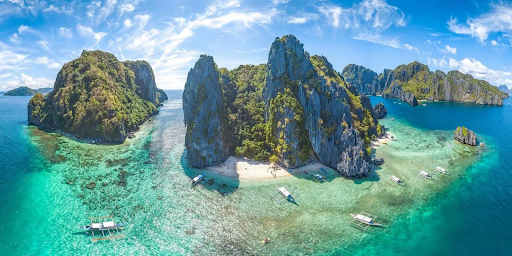
The Philippines spans more than 7,600 islands, and that geography changes everything about how you should plan a trip there. A single itinerary rarely covers both Luzon’s mountains and Palawan’s lagoons in one go, and travelers who try to cram too much in often end up spending more time in transit than on the beach. These eight tips will help you plan smarter, avoid common missteps, and get more out of the trip.
Pick a region instead of trying to see it all
Manila to Palawan is roughly the same distance as Los Angeles to Denver, and inter-island travel usually means flying, not driving. Trying to hit Boracay, Siargao, and Bohol in a single 10-day trip usually means losing whole days to airports and ferry terminals. Choose one or two regions — say, El Nido and Coron in Palawan, or Cebu and Siquijor in the Visayas — and build a slower itinerary around them.
Book domestic flights early and build in buffer days
Domestic carriers like Cebu Pacific and Philippine Airlines connect most major islands, but flight schedules can shift or get cancelled with little notice, especially during typhoon season from June through November. A delay in Coron or Siargao can easily eat a full day. Add at least one buffer day between island-hopping legs so a weather delay doesn’t wreck the rest of the trip.
Carry cash, especially outside major cities
Credit cards work fine in Manila, Cebu City, and most resort areas, but smaller towns, tricycle drivers, and local eateries operate almost entirely on cash. ATMs are common in cities but scarce on smaller islands like Siargao or the outer parts of Palawan, and they sometimes run out of bills during peak season. Withdraw more than feels necessary before heading somewhere remote, and keep small bills on hand for boat fees, entrance fees, and environmental fees that many tourist spots charge separately from the main ticket price.
Time the trip around the season, not just the calendar
The dry season, roughly November through May, is the most reliable window for island-hopping and diving, with March to May bringing the hottest, driest weather. June through October is wetter and riskier for typhoons, particularly in the northern and central Philippines, though Mindanao and parts of the south see less disruption. December through February is peak tourist season with the best weather and the highest prices, so booking accommodations and Philippines tours several months ahead makes a real difference if traveling around the holidays.
Learn a few Tagalog and Bisaya phrases
English is widely spoken and used in schools and government, so language barriers are rarely a serious obstacle. Still, a simple “salamat” (thank you) or “magkano” (how much) goes a long way with vendors, drivers, and hosts, and it tends to shift interactions from transactional to genuinely warm. In the Visayas and Mindanao, Bisaya is more common than Tagalog, so a phrase like “salamat kaayo” fits better there than the Tagalog equivalent.
Negotiate transport fares before getting in
Tricycles, habal-habal (motorcycle taxis), and non-metered vans typically don’t have fixed rates, and prices can shift noticeably based on how the fare gets negotiated. Ask locally what a fair price looks like for a given distance, whether at a hotel front desk or a nearby shop, before flagging down a ride. Ride-hailing apps like Grab work well in Manila, Cebu, and a handful of other cities, offering fixed pricing and removing the guesswork entirely.
Pack for humidity and unpredictable rain
Even in the dry season, afternoon showers are common, particularly in mountainous or forested areas like Banaue or the Chocolate Hills. Lightweight, quick-dry clothing handles the humidity far better than cotton, which stays damp for hours in tropical conditions. A compact rain jacket or poncho, a dry bag for boat trips, and reef-safe sunscreen cover most of what the weather is likely to throw at a trip.
Respect local customs around dress and behavior at religious sites
The Philippines is around 80 percent Catholic, and churches such as the Basilica of the Santo Niño in Cebu or the Baclayon Church in Bohol still expect modest dress, meaning covered shoulders and knees. In Muslim-majority areas like parts of Mindanao and Palawan’s southern towns, similar modesty applies, particularly around mosques. Bringing a lightweight scarf or sarong solves this problem without needing to plan an entire outfit around it.
Planning a Philippines trip comes down to accepting that the islands don’t function as one connected destination but as dozens of separate ones loosely tied together by ferries and short flights. Picking a manageable region, padding the itinerary with buffer time, and carrying enough cash will solve most of the logistical headaches before they start. The rest — the food, the diving, the quiet islands with no cars at all — tends to take care of itself once the logistics are handled.