
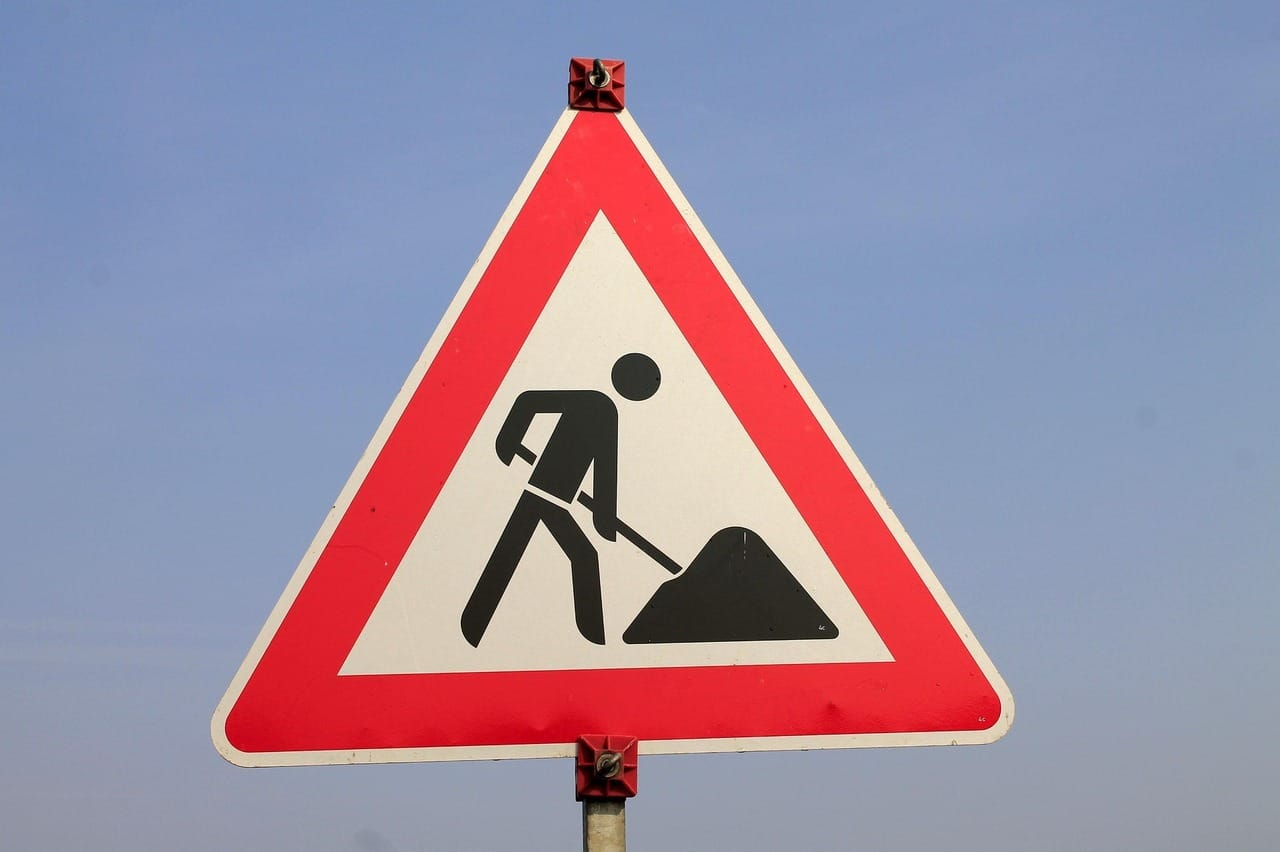
Controlling who can and can’t walk onto a site is a personal legal duty on the contractor. It’s not even just about protecting against worst-case scenarios. The laws are enforceable, whether or not anyone is hurt, and essential access signage for construction work zones is one of the most direct ways to meet it.
The legal duty behind the signage
The obligation all stems from the Construction (Design and Management) Regulations 2015. Regulation 13(4)(b), to be exact, is what requires the principal contractor to make sure “the necessary steps are taken to prevent access by unauthorised persons to the construction site.” That’s a specific, named duty on a specific, named dutyholder. So, not a general tone-driven guideline about site tidiness.
Regulation 18 then fleshes out what “the necessary steps” actually look like when it comes down to it. Because site managers need actionable steps and examples.
Where necessary for health and safety, a site must, so far as reasonably practicable and in line with the level of risk, have its perimeter clearly marked out by suitable signs and be arranged so its extent is easily identifiable. And/or just be fenced off.
The regulations do afford site managers a choice of method, but signage that clearly marks where the work zone starts and who’s permitted past that point is doing most of the heavy lifting here. Regulation 18(1) adds a related duty too, which is that each part of a site must, so far as reasonably practicable, be kept in good order, which reinforces that access control isn’t just one isolated box to tick but part of the same general standard of site management the rest of CDM 2015 expects. They all tie into each other.
This matters because unauthorised persons isn’t limited to youths and trespassers with bad intent. It’s clearly talking about delivery drivers who’ve wandered past the marked entrance, or members of the public taking a shortcut. And, perhaps most seriously of all, children drawn to a site that looks like an adventure playground. But a deadly one.
So, consistently placed signage that marks the boundary and directs everyone toward a controlled entry point is what turns a paper duty into something a site actually complies with day to day.
What happens when access isn’t controlled
The consequences of getting this wrong are pretty dire and the law makes it very clear it isn’t only about workers being hurt. Howard Civil Engineering Ltd, a civils contractor based in Leeds, was fined £600,000 plus £43,000 in costs at Sheffield Crown Court after seven-year-old Conley Thompson became trapped and died in a drainage pipe on the company’s Worsborough site in South Yorkshire.
HSE’s investigation found insufficient fencing in place to prevent unauthorised persons from accessing the site. It was a breach of Regulation 13(4)(b) and a breach of Section 3(1) per Health & Safety at Work Act 1974. The site was adjacent to busy footpaths and a housing estate, which is exactly the kind of place where the boundary between public space and active construction site should be unmistakable rather than implied. The company pleaded guilty.
The fine reflected not a workplace accident in the conventional sense, but a failure to keep unauthorised people out in the first place. It’s not like heavy machinery red tape in logistics. It was the exact duty that access signage exists to support. Sentencing at this level is about reflecting both the harm caused and the company’s culpability in failing to act on a foreseeable risk. It’s all about preventable risk rather than a one-off lapse.
Why this keeps being enforced
The reason HSE treats access control as a serious and standalone compliance area is that construction is still, by some way, the deadliest sector in the west. HSE’s fatal injury statistics for the year ending March 2025 recorded 124 worker deaths across all industries in Great Britain — and construction accounted for 35 of them, more than any other sector, well ahead of agriculture, forestry and fishing (23) and manufacturing (11). Falls from height were the leading cause (around half of all construction deaths).
That figure covers workers who are on the payroll and trained. It doesn’t even touch on the additional risks and accidents a site carries for anyone who ends up inside its boundary without authorisation and PPE.
A site with 35 sector-wide worker deaths a year as its baseline risk profile is not a site where “the gate was probably fine” is an actual, adequate standard. Clear signage, positioned at every point someone could reasonably enter, is the low-cost and high-visibility control needed. It’s your defence if someone does climb the fence and get hurt. And, really, it’s one of the best ROIs you can imagine in that instant. Cheapest, easy to put up, and offering passive protection from then on.