
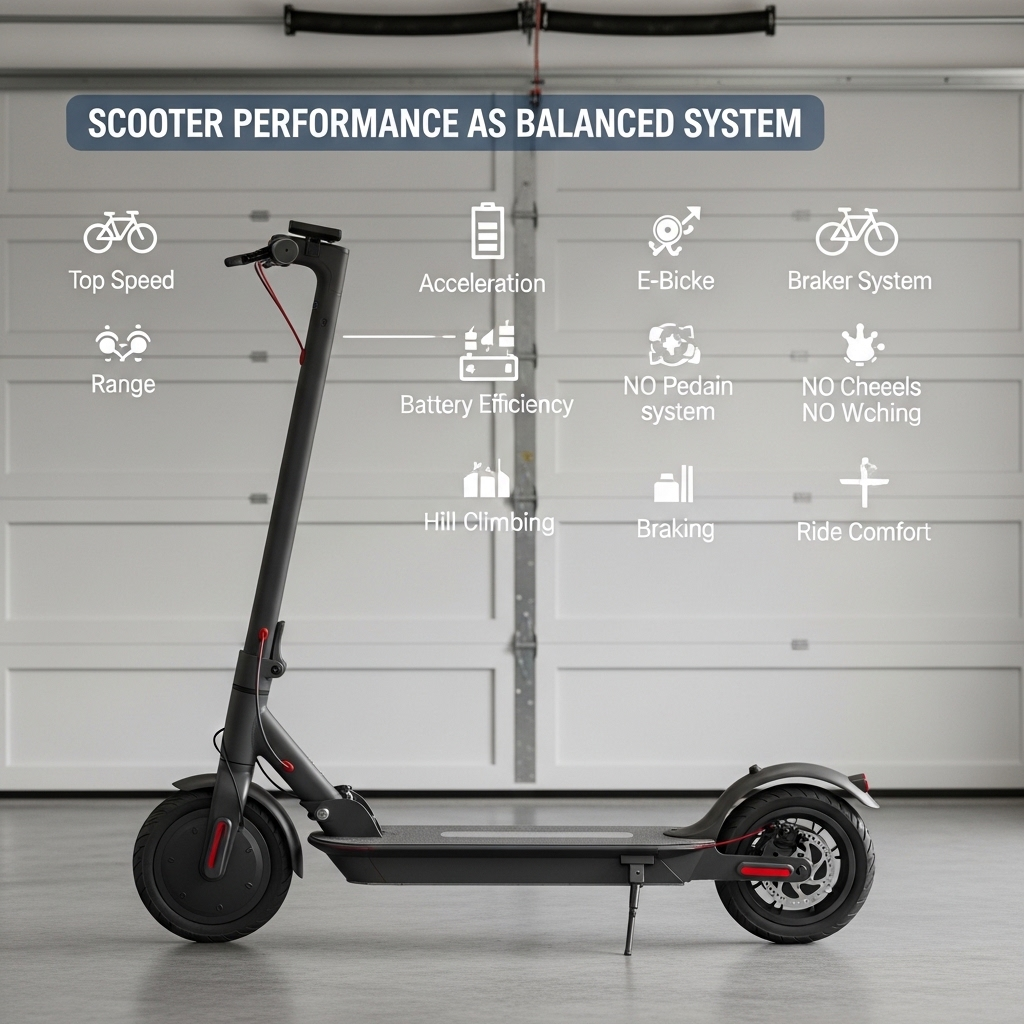
High-performance electric scooters differ from basic commuter models in several important ways. Their performance comes from the way multiple systems work together. Motor output matters, but it does not tell the whole story.
A powerful scooter also needs stable handling, effective braking, suitable tyres and controlled acceleration. The battery must support the motors without making the scooter impractical for everyday use.
Understanding these factors helps buyers look beyond headline specifications. It also makes it easier to choose a scooter that suits the roads, paths and terrain they expect to use.
Power Starts With the Motor System
Motor power affects how an electric scooter responds when the rider opens the throttle. A stronger motor can provide more force at the wheel. This can help the scooter accelerate and handle inclines more effectively.
However, motor power should not be viewed in isolation. The controller, battery, drivetrain and rider weight all influence real-world performance.
A scooter can have a powerful motor but still feel poorly controlled. Good performance depends on how smoothly the system delivers its available power.
Single-Motor and Dual-Motor Configurations
Single-motor scooters send drive power through one motor. This arrangement can reduce mechanical complexity and often suits straightforward urban travel.
Dual-motor scooters use two motors to deliver drive power. The system can distribute propulsion across both wheels, depending on the scooter’s design and control system.
For riders who regularly face hills, loose surfaces or demanding terrain, this configuration can offer useful advantages. It can also improve traction when both motors contribute to propulsion.
The difference becomes particularly relevant when conditions change. Wet surfaces, uneven paths and steep gradients can demand more from the drive system than smooth, level roads.
This is why dual-motor electric scooters can appeal to riders who want stronger propulsion and greater capability across varied riding conditions. The important point is that two motors are not automatically better for every rider. Their value depends on where and how the scooter will be used.
Acceleration Needs More Than Raw Power
Strong acceleration can make a scooter feel responsive, but uncontrolled acceleration can make riding less comfortable. A high-performance scooter should therefore manage power delivery as well as produce it.
The controller determines how electrical power reaches the motor. Its programming can affect throttle response and acceleration behaviour.
A smooth response helps the rider make small adjustments. This matters when moving through traffic, starting from a junction or travelling over uneven ground.
Riders should also consider different riding modes when available. Lower power settings can make slow-speed riding easier. Higher settings can provide additional performance when conditions allow it.
Rider Weight Changes Performance
The rider’s weight affects acceleration and climbing ability. A heavier load requires more force to achieve the same acceleration.
Carrying luggage has a similar effect. Extra weight increases the demand on the motor and battery.
Terrain adds another variable. A scooter travelling uphill needs more energy than one travelling on a flat road. Therefore, published performance figures should always be considered alongside the rider’s expected conditions.
Stability Separates Performance From Usability
Power alone does not create a good high-performance scooter. Stability determines how confidently a rider can control that power.
A stable scooter should provide predictable steering and a planted feel under normal riding conditions. The deck, handlebar position, wheel size, suspension and overall chassis design can all influence this experience.
Higher performance also increases the importance of stability. As acceleration increases, the rider needs enough control to manage changes in speed.
Deck Design and Rider Position
The deck provides the rider’s main standing platform. A suitable deck gives the rider enough room to adopt a comfortable stance.
Rider position affects balance during acceleration and braking. A stable stance can make it easier to respond to bumps or changes in direction.
Handlebar geometry also matters. A rider needs enough control to steer without making sudden movements.
The best setup depends on body size and riding style. A configuration that feels comfortable for one rider may feel less natural for another.
Tyres Influence Grip and Comfort
Tyres provide the contact between the scooter and the riding surface. Their construction and tread affect grip, stability and comfort.
Road-focused tyres can suit smooth urban surfaces. More aggressive tread patterns can provide better suitability for loose or uneven ground.
Tyre pressure also affects handling. Incorrect pressure can change the scooter’s ride characteristics and reduce the effectiveness of the tyre.
Riders should therefore treat tyres as a performance component rather than a minor detail. The right tyre setup can make a noticeable difference to how a powerful scooter behaves.
Suspension Helps Manage Uneven Surfaces
Suspension helps reduce the impact of bumps and uneven surfaces reaching the rider. It can also help the wheels maintain more consistent contact with the ground.
This becomes particularly useful on rough roads, tracks and other imperfect surfaces. Without suitable suspension, repeated impacts can make a scooter uncomfortable and harder to control.
Suspension design also affects handling. Too little compliance can produce a harsh ride. Too much movement can make the scooter feel less precise.
The right balance depends on the intended use. A scooter designed mainly for smooth roads may need a different setup from one intended for mixed or off-road conditions.
Braking Must Match Available Performance
A scooter that can accelerate strongly must also allow the rider to slow down with confidence. Braking therefore forms a central part of the performance equation.
Electric scooters can use electronic braking, mechanical braking or a combination of both. Mechanical brakes create stopping force through physical braking components. Electronic systems can use the motor to help slow the scooter.
The exact braking system varies between models. Buyers should check the manufacturer’s specifications rather than assume that every performance scooter uses the same arrangement.
Brake feel matters as well. Predictable braking allows the rider to make controlled adjustments rather than sudden reactions.
Regular inspection is equally important. Brake components can wear over time, especially when the scooter is used frequently or in demanding conditions.
Battery Capacity Determines More Than Range
The battery supplies energy to the motor system. Its capacity therefore has a direct relationship with potential riding distance.
However, battery capacity alone does not guarantee a particular range. Real-world range depends on several variables.
Motor demand is one of the largest factors. Frequent acceleration requires more energy than steady riding.
Terrain also matters. Hills increase energy consumption. Loose surfaces can create additional rolling resistance.
Rider weight, tyre pressure, riding speed and weather can also affect energy use. Frequent stops and starts may place greater demands on the battery than steady cruising.
Why Claimed Range Can Differ From Real Use
Manufacturers may test range under controlled conditions. Real riding rarely matches those conditions exactly.
A rider travelling on flat roads at a moderate pace may achieve a different result from someone riding quickly across hills.
Cold weather can also affect battery performance. Strong headwinds create additional resistance, while rough surfaces can increase energy demand.
For this reason, buyers should treat a claimed range as a reference point rather than a guaranteed distance for every journey.
Ride Control Makes Power Easier to Use
High-performance scooters need effective control systems. The rider should be able to regulate acceleration without fighting the machine.
Throttle sensitivity plays a major role. A very sensitive throttle can feel abrupt at low speeds. A smoother response can make manoeuvring easier.
Different power modes can also help. A lower setting may suit crowded areas or inexperienced riders. A stronger setting can be useful where additional acceleration is appropriate.
Control should remain predictable across different conditions. This is particularly important when a scooter has enough power to change speed quickly.
Practical Use Matters as Much as Performance
A high-performance scooter may offer strong acceleration and improved capability, but those features only matter if they suit the rider’s routine.
A heavier scooter can be harder to carry upstairs or place in a vehicle. Larger components may also require more storage space.
Battery charging is another practical consideration. Riders should think about where they will charge the scooter and how frequently they expect to ride.
Weather exposure also deserves attention. Water resistance, storage conditions and maintenance requirements vary between models. Buyers should check the manufacturer’s guidance before riding in wet conditions.
Urban Riding
For urban riders, acceleration can help when joining traffic or climbing inclines. Stable handling can also improve confidence on uneven roads.
However, maximum performance may not always be necessary in a busy environment. A controllable power mode can be more useful than simply having the highest available output.
Mixed and Rough Terrain
Riders who use uneven paths need to consider more than motor power. Suspension, tyre design, ground clearance and chassis stability become increasingly important.
Dual-motor drive can provide useful traction in demanding conditions. Yet the rider still needs appropriate technique and sensible speed.
A performance scooter cannot remove the risks created by loose ground, potholes or sudden changes in surface conditions.
Advantages of High-Performance Electric Scooters
Stronger Propulsion
Higher-performance systems can provide stronger acceleration and better hill-climbing capability when compared with less powerful configurations.
Greater Traction Potential
Dual-motor designs can distribute propulsion across two driven wheels. This can be useful when surface conditions make traction more difficult.
Better Capability Across Varied Terrain
Suitable suspension and tyres can make a performance scooter more adaptable to uneven roads and mixed surfaces.
More Control Options
Performance-oriented models may offer multiple riding modes. These can help riders select a response that matches their surroundings.
Greater Performance Headroom
Extra motor capability can reduce the need to operate the system at its limits during demanding journeys. This can be useful for heavier riders or routes with regular gradients.
Limitations to Consider
Higher Weight
Performance components can increase overall scooter weight. This may make carrying and storage less convenient.
Greater Battery Demand
Using stronger acceleration and higher power settings can consume energy more quickly. Riders who prioritise performance may therefore see lower real-world range.
More Complex Maintenance
A scooter with more systems can require more components to inspect and maintain. Tyres, brakes, suspension and electrical systems all need attention.
Higher Cost Potential
High-performance hardware can increase the purchase price. Buyers should compare the features they actually need rather than paying for performance they will rarely use.
More Demanding Handling
Strong acceleration requires good throttle control. Riders who are unfamiliar with powerful scooters may need time to adapt.
What Buyers Should Check Before Choosing
Start with the intended riding environment. Consider whether most journeys will take place on smooth roads, hills, rough paths or mixed terrain.
Next, assess the motor configuration. A single motor may suit straightforward commuting. A dual-motor setup can make more sense for demanding terrain or riders who prioritise stronger propulsion.
Then look at stability. Check the deck, handlebars, tyres and suspension as a complete system rather than judging each component separately.
Battery performance should come next. Consider the distance of your normal journeys and how often you can recharge. Remember that real-world range varies with speed, terrain, rider weight and conditions.
Braking deserves equal attention. A high-performance scooter should provide braking equipment that matches its performance capabilities.
Finally, consider ownership. Storage, charging, carrying weight and maintenance can affect everyday satisfaction just as much as acceleration.
Matching Performance to Real Riding Needs
The best high-performance electric scooter is not necessarily the one with the most impressive specification sheet. It is the one whose performance matches the rider’s actual needs.
Motor configuration matters when travelling over demanding terrain. Stability becomes more important as power increases. Battery performance affects how far the scooter can travel between charges.
Tyres, suspension and braking complete the picture. Together, these systems determine how usable the available power becomes.
Buyers should therefore evaluate the whole scooter rather than focusing on a single figure. A balanced combination of power, stability, range and control can provide a more useful riding experience than maximum output alone.
For riders comparing performance scooters, the most sensible approach is to identify their regular routes first. Once the terrain, distance, rider weight and storage requirements are clear, it becomes much easier to decide which performance features genuinely add value.