
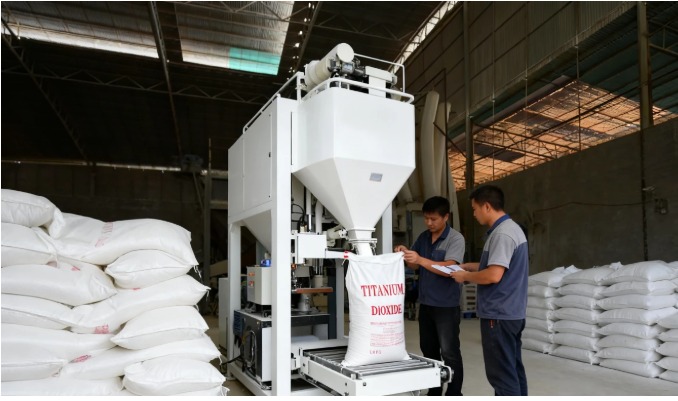
Few industrial minerals are as widely used as titanium dioxide (TiO2). It brightens the plastic housing of a household appliance, keeps a food wrapper opaque, and helps a sunscreen protect skin from ultraviolet light. Chemical engineers value it for its exceptional whiteness, brightness, light-scattering power and chemical stability. This article covers what titanium dioxide is, how its crystal forms differ, and why it matters in plastics, packaging and cosmetics.
What Is Titanium Dioxide and Why Does It Matter?
Titanium dioxide is a naturally occurring oxide of titanium, produced industrially from ores such as ilmenite and rutile. It has the highest refractive index of any commercially used white pigment, so it scatters visible light very efficiently. That is why a thin layer of TiO2 can turn a transparent polymer or coating into a bright, opaque white.
Demand spans paints, inks, paper, plastics, rubber, ceramics, food-contact materials and personal care. Manufacturers that need consistent particle size, purity and dispersion often source through established titanium dioxide distributors, who can match grades to specific processing conditions and supply volumes. Choosing the right grade early prevents costly problems later, such as poor dispersion, yellowing or weak opacity.
Rutile and Anatase: Understanding the Crystal Forms
Titanium dioxide is commercially produced in two main crystal structures, rutile and anatase. They share a chemical formula but behave differently.
Rutile has a denser crystal lattice and a higher refractive index. It is more stable under heat and light and resists photocatalytic activity better, which makes it the preferred choice for outdoor and long-life applications.
Anatase is slightly softer and often appears bluer in tone. It is used where high photocatalytic activity is wanted, such as self-cleaning surfaces, or where cost and a softer pigment matter more than weather resistance.
Two industrial routes produce the pigment. The sulfate process digests the ore in sulfuric acid and can yield either form. The chloride process reacts the feedstock with chlorine at high temperature to make titanium tetrachloride, which is then oxidized to give a very pure rutile pigment with excellent whiteness. Surface treatments with alumina, silica or zirconia are applied afterward to improve dispersion and durability.
Titanium Dioxide in Plastics
In the plastics industry, TiO2 is the standard white pigment for masterbatches and compounds. Polyethylene, polypropylene, PVC, polystyrene and engineering resins all rely on it for color and opacity.
Its value goes beyond appearance. TiO2 absorbs and scatters ultraviolet radiation, which slows the photodegradation of polymers exposed to sunlight. This matters for window profiles, pipes, garden furniture, automotive parts and agricultural films. Without a UV-blocking pigment, many plastics would chalk, crack or discolor within a few seasons.
Processing engineers focus on a few key variables:
- Dispersion quality: Poorly dispersed agglomerates cause specks, weak spots and uneven color.
- Loading level: Typical loadings range from a few percent up to 20 percent or more in highly opaque products.
- Heat stability: The pigment must withstand extrusion and injection-molding temperatures without degrading the polymer.
- Surface treatment: Coatings on the particle improve compatibility with the resin and reduce lacing or die build-up.
Rutile TiO2 for Packaging Applications
Packaging relies on titanium dioxide for protection as much as for looks. White inner layers in multilayer films and bottles block light, which helps preserve dairy products, beverages and pharmaceuticals that degrade when exposed to it. On printed outer surfaces, a bright white base coat makes colors look sharper and more vivid.
For these demanding uses, converters typically look for a dependable rutile TiO2 supplier that can provide consistent particle size distribution, low impurity levels and technical support for film extrusion, coating and ink formulation. The high durability of the rutile form suits flexible packaging, rigid containers, labels and paperboard that must keep their appearance through shipping, storage and shelf life.
Sustainability is shaping this sector too. Because TiO2 delivers opacity at relatively thin layers, it can help reduce material use and allow lighter packaging designs, which supports lightweighting goals.
Titanium Dioxide in Cosmetics and Personal Care
In cosmetics, titanium dioxide appears in foundations, powders, creams and, most notably, mineral sunscreens. As a physical UV filter, it sits on the skin and reflects and scatters ultraviolet rays rather than absorbing them chemically. It is particularly effective against UVB and short-wave UVA, and it is often paired with zinc oxide for broader coverage.
Formulators favor cosmetic-grade TiO2 for several reasons:
- It is chemically inert and has a long record of use in skin-care products.
- It adds opacity and a smooth, natural-looking finish to makeup.
- It suits sensitive skin better than many organic filters.
Particle size is central here. Micronized and nano-scale grades reduce the white cast on skin while keeping UV protection, but they require careful surface coating and dispersion in the formula. Regulations on particle size, concentration and permitted uses differ by region, so formulators should check current requirements in each target market, particularly for sprayable and powder products.
Quality, Safety and Regulatory Considerations
Selecting titanium dioxide is partly a technical decision and partly a compliance one. Engineers typically evaluate:
- Purity and heavy-metal limits appropriate to the end use.
- Particle size and distribution, which directly affect opacity and tinting strength.
- Surface treatment matched to the polymer, solvent or cosmetic base.
- Documentation, including safety data sheets, food-contact and cosmetic compliance statements, and batch-to-batch quality records.
Regulatory attitudes toward TiO2 vary by application and region, with particular scrutiny of its use in food and of inhalable powder forms. Staying informed and working with suppliers who track these changes helps manufacturers avoid disruption.
Conclusion
Titanium dioxide remains one of the most important functional pigments in modern chemical engineering. Its brightness, opacity, UV protection and stability make it valuable in plastics, packaging and cosmetics alike, and understanding the differences between rutile and anatase, surface treatments and particle sizes helps formulators choose the right grade. Careful attention to dispersion, quality control and regulation turns a good pigment into a reliable, high-performing product. For more details on titanium dioxide grades and applications, please visit tio2manufacturer.com.