
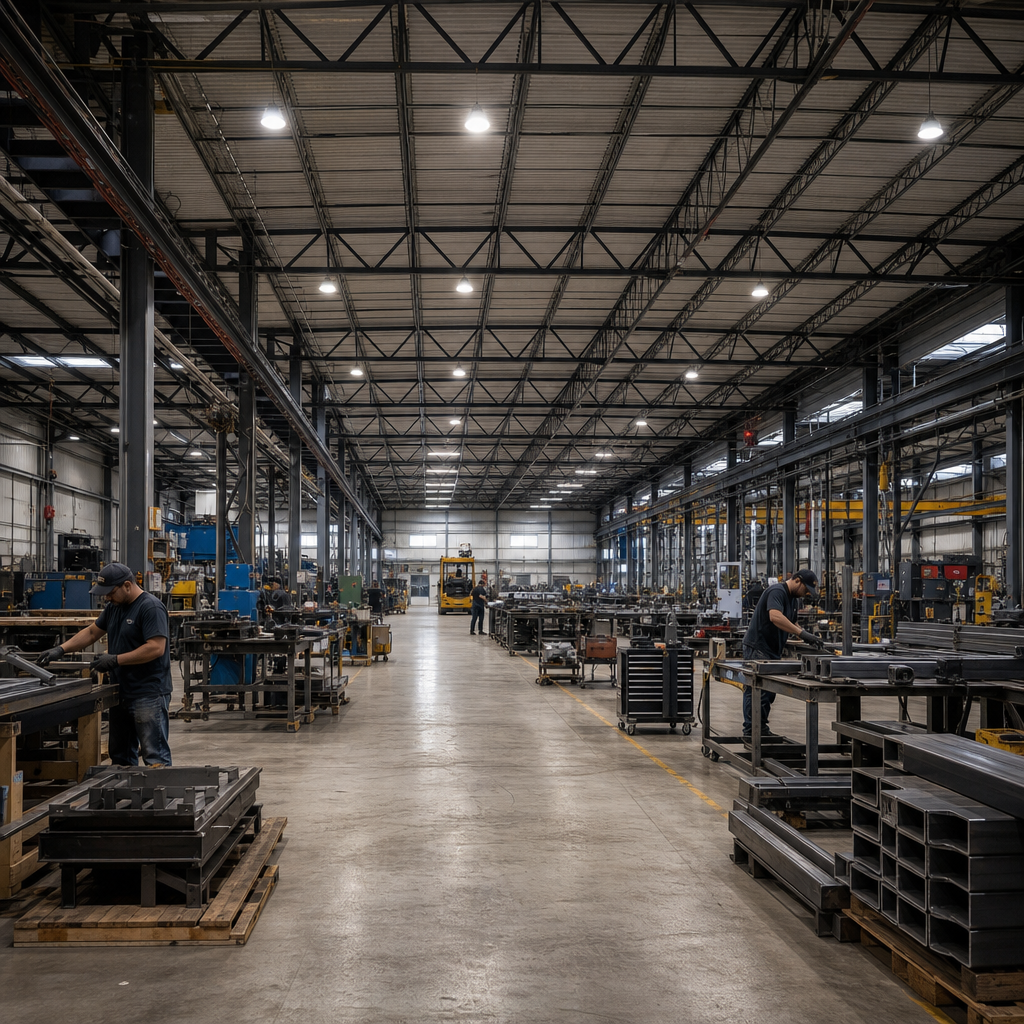
The Scale of Skilled Manufacturing in Modern America
There is a quiet revolution happening in American manufacturing, and it is not driven by automation alone. It is driven by people — skilled, experienced craftspeople who bring precision, creativity, and accountability to every project they touch. When a fabrication facility houses 225 of these professionals under one roof spanning 127,000 square feet, the result is not just production capacity. It is a concentrated ecosystem of expertise that few operations in the country can match. Understanding what makes such a facility exceptional requires looking beyond the square footage and headcount, and examining the culture, processes, and capabilities that define world-class custom fabrication.
What 127,000 Square Feet of Fabrication Space Actually Means
Square footage in a manufacturing context is more than a real estate metric. It is a direct indicator of operational versatility. A 127,000 square foot facility can accommodate large-format projects that smaller shops simply cannot take on — oversized vehicle wraps, complex structural builds, specialty trailers, and industrial equipment that demands room to maneuver, assemble, and inspect at every stage of production.
In the St. Charles facility, that space is organized with intentional workflow design. Raw materials enter at one end of the production chain, and finished, quality-inspected products exit at the other. Between those two points lies a carefully choreographed sequence of fabrication, welding, painting, graphics application, and systems integration. The physical layout reduces bottlenecks, minimizes handling errors, and allows multiple large projects to progress simultaneously without interference.
Workflow Design as a Competitive Advantage
Many fabrication operations grow organically, adding space and equipment as demand increases, which often results in fragmented workflows and inefficiencies. A purpose-built or strategically organized facility, by contrast, treats workflow as a core engineering challenge. When every station — from metal forming to final inspection — is positioned to minimize transit time and maximize communication between teams, quality improves and lead times shrink. This kind of spatial intelligence is what separates a facility that merely has capacity from one that consistently delivers on complex, high-stakes projects.
The Human Element: 225 Craftspeople and Why That Number Matters
Automation has transformed manufacturing, but it has not replaced the judgment, adaptability, and craftsmanship that skilled human workers bring to custom fabrication. A workforce of 225 craftspeople represents a significant investment in human capital — one that pays dividends in the form of problem-solving capability, quality ownership, and the ability to handle projects that fall outside standard parameters.
Custom fabrication, by its very nature, involves variables that automated systems struggle to accommodate. A client may need a one-of-a-kind mobile command unit, a specialty promotional vehicle, or a complex industrial trailer with unique structural requirements. These projects demand workers who can read blueprints, adapt to unexpected challenges, and apply years of hands-on experience to deliver results that meet exacting specifications. A team of 225 craftspeople, working within a well-organized facility, creates the kind of redundancy and specialization that allows a company to take on diverse, demanding projects without sacrificing quality or timelines.
Specialization Within a Large Team
Within a workforce of this size, specialization becomes possible in ways that smaller operations cannot achieve. Welders, fabricators, painters, graphic artists, electrical systems technicians, and quality control specialists can each develop deep expertise in their domain while collaborating seamlessly with colleagues in adjacent disciplines. This division of skilled labor, combined with strong project management, is what allows a large facility to maintain the attention to detail typically associated with boutique custom shops.
Craftsmen Industries: A Benchmark for Custom Fabrication Excellence
With 225 craftspeople and a 127,000 sq ft St. Charles facility, Craftsmen Industries has established itself as one of the most capable custom fabrication operations in the United States. The company’s scope spans specialty vehicles, mobile marketing units, industrial trailers, and branded experiential builds — a portfolio that reflects both the breadth of its capabilities and the depth of its technical expertise. What distinguishes this operation is not simply its size, but the way that size is leveraged to deliver consistent, high-quality outcomes across an exceptionally diverse range of client needs.
Industrial Process Standards and the Fabrication Connection
The standards that govern industrial fabrication are not arbitrary. They exist because the consequences of failure in manufactured equipment — whether a specialty vehicle, a process vessel, or a structural component — can be severe. Across industries, there is growing recognition that material selection, surface treatment, and construction methodology are not secondary concerns but primary determinants of product longevity and performance. For those interested in how material science intersects with fabrication quality, understanding why certain vessel technologies remain the gold standard in industrial process equipment offers valuable context for the broader conversation about manufacturing excellence.
Quality Control at Scale
One of the most persistent challenges in large-scale fabrication is maintaining quality control as production volume increases. The temptation to prioritize throughput over precision is real, and it is a temptation that distinguishes average operations from exceptional ones. In a facility housing hundreds of craftspeople, quality must be embedded in the culture, not bolted on at the end of the production line. This means regular training, clear accountability structures, documented inspection protocols, and a workforce that takes genuine pride in the work they produce.
The Broader Trend: Investment in Fabrication Infrastructure
The investment in large-scale fabrication facilities is a trend visible across multiple industries. As demand for custom, high-specification manufactured products grows, companies are recognizing that facility capacity and workforce depth are strategic assets. This is evident not only in traditional manufacturing sectors but also in emerging technology industries, where companies like Nanox are accelerating the construction of fabrication plants to meet rapidly expanding production requirements. The common thread across these investments is the recognition that physical infrastructure and skilled labor are not costs to be minimized but capabilities to be cultivated.
St. Charles as a Manufacturing Hub
The choice of St. Charles as the location for a major fabrication facility reflects broader patterns in American manufacturing geography. The region offers access to skilled labor, transportation infrastructure, and a manufacturing culture that supports the kind of long-term workforce development that complex custom fabrication requires. Facilities of this scale do not emerge overnight — they are the product of sustained investment in people, equipment, and operational systems over many years.
Conclusion: Scale, Skill, and the Future of Custom Fabrication
The combination of 225 craftspeople and 127,000 square feet of dedicated fabrication space represents more than a set of impressive statistics. It represents a philosophy — one that holds that the best manufactured products emerge from the intersection of human expertise, physical capacity, and organizational discipline. As industries continue to demand more complex, more customized, and more precisely engineered products, facilities that have made this kind of investment will be positioned to lead. The St. Charles operation stands as a compelling example of what American custom fabrication can achieve when scale and craftsmanship are treated not as opposing forces, but as complementary strengths.