
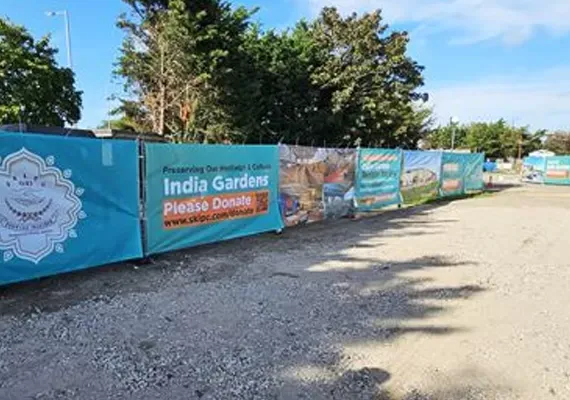
A development site is a public statement before it is a building. From the moment the hoarding panels go up to the day the doors open, the panels surrounding the site communicate something about the development and the people behind it to every person who passes. In a city where attention is limited and competition for it is relentless, this extended, permanent public presence is too valuable to waste on a blank fence. The developments that understand this, and invest accordingly in the quality and design of their hoarding panels, consistently establish a stronger market position than those that do not.
The Attention Economy of the Construction Site
Every construction site competes for public attention. Well-designed hoarding panels help capture interest and keep the development visible throughout the project.
Why Hoardings Compete With Everything Else for Eyeballs
Every person who passes a construction site is making an unconscious attention allocation. If the hoardings offer nothing, blank boards, a generic safety notice, faded contractor branding, the attention moves elsewhere immediately. If they offer something genuinely interesting, a compelling visual, a clear promise about what is coming, an acknowledgement of the local community’s patience, they capture and hold that attention for a moment that accumulates in value with every repetition.
The same person passing the same site five days a week for six months represents significant cumulative exposure to whatever message the hoarding panels carry. Used well, that exposure builds awareness, anticipation, and commercial interest. Used poorly, or not at all, it represents an opportunity measured in thousands of impression-hours that simply does not get used.
The Strategic Functions Well-Designed Hoardings Serve
Well-designed hoarding panels do more than secure a site. They combine practical, branding, and marketing objectives to create a stronger public presence throughout the development.
More Than a Boundary: A Communication Platform
Great hoardings serve several strategic functions simultaneously, and the best-designed installations make all of them work together without any single function dominating awkwardly.
Security and compliance: the baseline requirement, met properly and without compromise.
Brand establishment: the developer’s or contractor’s visual identity, presented consistently and professionally for the duration of the project.
Vision communication: architectural renders, development narrative, and future-state imagery that invite the community into the story of what is being built.
Commercial activation: enquiry generation, pre-sales, pre-leasing, and the beginning of the sales campaign before the development is structurally complete.
Community relationship management: acknowledgement of disruption, transparency about timeline, and genuine respect for the neighbourhood expressed through the quality and content of the installation.
What Separates Good Hoarding Panels From Forgettable Ones
| Design Element | What Good Looks Like | What Forgettable Looks Like |
| Architectural renders | High quality, eye-level, contextually placed | Small, printed too dark, not placed for pedestrian viewing |
| Brand identity | Consistent, professional, integrated into the design | Logo placed as an afterthought on an otherwise generic panel |
| Community messaging | Specific, warm, genuinely respectful | A conventional “thank you for your patience” message with minimal visual appeal |
| Contact information | Clear, large, with QR code for digital engagement | Small text in an inconspicuous location |
| Visual coherence | Panels designed as a sequence with visual flow | Individual panels that do not relate to each other |
The Production Quality That Maintains Impression Over Time
Hoarding panels that look excellent in the first month and deteriorating by month six communicate something unintended, that the same attention to quality does not extend through the life of the project. For developments promoted as premium spaces, this affects brand perception just as much as ongoing maintenance.
Specifying materials and print finishes that are genuinely appropriate to the expected installation period, UV-stable inks, laminated surfaces, robust panel systems, is the production decision that protects the investment in design throughout the full duration of the project.
Keeping Hoarding Panels Relevant Throughout the Project
Refreshing hoarding panels as construction progresses keeps the development visible and the messaging relevant throughout the project.
Adapting the Message as the Development Progresses
Hoarding panels do not have to remain unchanged from the first day of construction until completion. Updating selected panels as the project reaches key milestones helps keep the development relevant, encourages repeat engagement, and provides fresh information to people who pass the site regularly.
As construction progresses, hoarding panels can be refreshed to highlight:
- Construction milestones that demonstrate visible progress and build confidence in the project.
- New marketing messages reflecting sales launches, leasing opportunities, or upcoming opening dates.
- Updated visuals showing completed areas, refined architectural imagery, or finished interior concepts.
- Community information such as local partnerships, sustainability initiatives, or project achievements that strengthen public engagement.
Refreshing key sections throughout the build ensures the hoarding panels remain an active communication tool rather than a static display, helping maintain public interest until the development is complete.
Community Art as a Hoarding Strategy
For developments in high-footfall urban locations, community-commissioned artwork on hoardings is one of the most effective strategies available for building positive local sentiment. Panels that celebrate the history, culture, or character of the neighbourhood they surround communicate something about the development’s relationship with the area that no amount of corporate messaging achieves as authentically. The reduction in vandalism makes this strategy attractive not only for its financial advantages but also for protecting reputation.
Conclusion
Hoarding panels are a development’s most persistent public communication, present for months or years, seen thousands of times by the same local audiences, and making a cumulative impression that shapes the market reception of the project long before it completes. Treating them as a genuine communication and brand asset, rather than a regulatory necessity, is a strategic decision with measurable commercial and reputational returns. Hoarding Print Company works with developers and contractors who understand this, producing hoarding panels that give every development the public presence it deserves from the very first day on site.
Author Bio: Nimesh Kerai
Nimesh Kerai, the Printing Head at Hoarding Printing Company London, has a proven track record of delivering large format prints of unparalleled quality to customers. He is a technical expert as well as deeply understands the market and trends. His contribution to the company’s growth is undeniable. He often loves to share his extensive industry knowledge and market insights with a larger audience through interesting blog posts.