
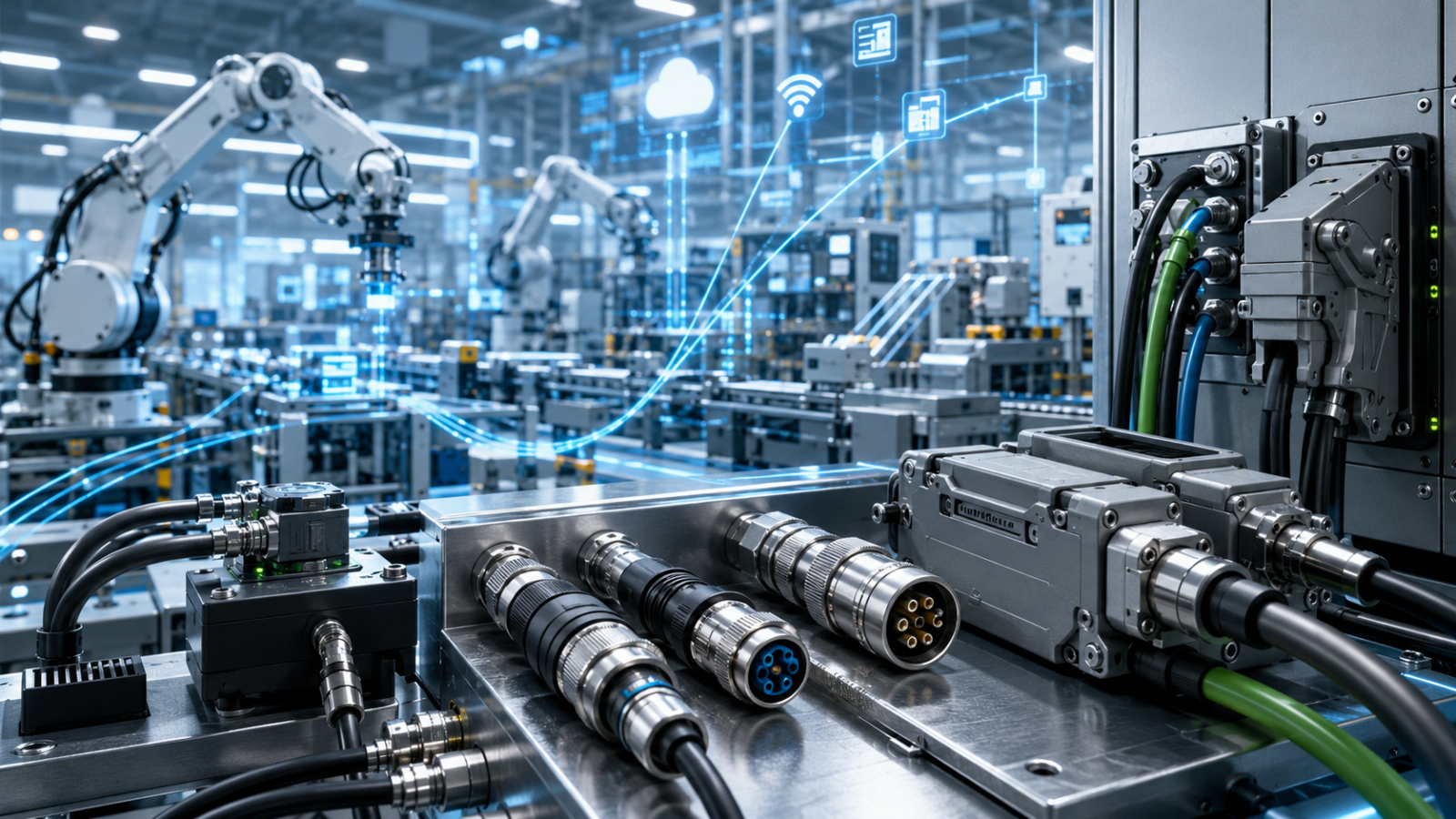
The transformative impact of industrial automation on such sectors of the economy as manufacturing, logistics, and energy production cannot be denied.
Today’s industrial automation applications, ranging from robotic assembly lines and automated warehouses to smart factories underpinned by Internet of Things (IoT) technologies, rely on the seamless exchange of power, data, and control signals.
The various industrial connectors available from RS, encompassing the likes of circular connectors, heavy-duty connectors, and power connectors, can play a central role in ensuring this.
However, not everyone necessarily understands the specifics of how such components do so.
The Importance of Connectors in Modern Industrial Automation
The industrial connector may appear a simple component, but it is also a critical one. These electromechanical devices provide a physical interface between machines, sensors, controllers, and networks.
In this context, connectors are vital for providing reliable connectivity. In the absence of this, even the most sophisticated automation systems would struggle to deliver the performance, efficiency, and uptime that modern industry demands.
Industry 4.0, And What Industrial Connectors Help Accomplish
Today, we are in the era of the Fourth Industrial Revolution, or “Industry 4.0”. It is an age characterised by the increasingly normalised use of smart, data-driven systems where machines communicate with each other and learn autonomously.
On this backdrop of ever-more widespread automated systems, connectors serve such critical functions as:
- The delivery of power to machinery and equipment
- The transmission of control signals between devices
- The support of high-speed data communication
- The enabling of rapid installation and maintenance
- The allowance for modular system design and scalability.
Manufacturers’ pursuits of Industry 4.0 initiatives are intensifying, not relenting. This coincides with sustained strong demand for robust, high-performance connectivity solutions.
When reliable connectors are used in industrial automation projects, this greatly helps ensure uninterrupted communication between sensors, programmable logic controllers (PLCs), drives, robots, and industrial networks.
Key Types of Industrial Connectors and Their Applications
Industrial connectors are supplied in a variety of forms, tailored to specific demands.
They include such components as:
- Circular Connectors (M8, M12, And Larger)
These devices are commonly referred to as the “workhorses” of industrial automation.
Among these are M12 connectors, so named because of their 12mm locking thread. They excel in harsh environments for sensors, actuators, and Industrial Ethernet.
As their name suggests, M8 connectors have a smaller diameter of circular locking mechanism than their M12 counterparts. This makes them well-suited to space-constrained applications; indeed, they are standardised internationally (IEC 61076-2-104) for compact sensors, actuators, and low-voltage industrial devices.
- Heavy-Duty And Industrial Power Connectors
Designed for high-current and high-voltage applications, these connectors deliver reliable power to machinery, motors, and robotic systems.
- Rectangular, DIN, And Backplane Connectors
These components see widespread use in control cabinets and PLC systems for board-to-board or modular connections.
- Data And Ethernet Connectors (RJ45, Fibre Optic)
Serving as the physical backbone for Industrial Ethernet networks, these connectors are essential for linking devices in real-time networks, supporting Gigabit speeds.
- Specialist Variants
These encompass the likes of push-pull, coded connectors for error-proof mating, as well as connectors supporting IO-Link for smart sensor integration.
Connectors like those set out in this list can greatly help protect sensitive electronics, at the same time as allowing for quick swaps during maintenance. The latter, for example, can be vital for minimising costly halts to production.
Connectors May Be Largely Invisible, But They’re Still a Backbone
The fact of connectors being relatively small components within a larger system should not cause someone to mistake or overlook their integral role.
After all, industrial automation installations of all kinds are greatly dependent on reliable connectivity. So, for engineers and organisations that care about the performance, safety, and uptime of their projects in this field, it will be essential to take great care over the selection of connectors to ensure they are up to the task.
As industry continues embracing ever-higher levels of automation, digitalisation, and Industry 4.0 technologies, robust and high-quality connectors will help ensure industrial automation applications are as efficient and productive as they need to be.